
Clogged AC Condensate Drain Line: Signs and Prevention for North Alabama Homes
July 31, 2026
What it is. A thermostat mounted where it doesn't sense the true average temperature of the home — in direct afternoon sun, on an exterior wall, near a sunny window, or above a heat-producing appliance.
Why it causes this symptom. A thermostat only knows the temperature at its own spot on the wall. If the afternoon sun lands on it, or it sits on a wall that heat-soaks late in the day, it reads warmer than the rest of the house and keeps calling for cooling it may never feel "satisfied" delivering — so the system runs and runs without ever clicking off. It can also work the other way, where a poorly placed thermostat shuts the system off early and lets distant rooms drift. Either way, the thermostat's afternoon reading is part of the story even when the equipment is healthy.
What should be measured or checked:
- A second thermometer placed in the main living area, compared against what the thermostat reports.
- Whether sun ever falls directly on the thermostat during the afternoon.
- Thermostat location relative to supply registers, exterior walls, and appliances.
More likely vs. less likely. More likely if the thermostat is on a sunny wall, near a window, or in a spot that clearly feels different from the rest of the house. Less likely if it sits on a shaded interior wall and matches a handheld thermometer.
Homeowner vs. pro:
Comparing the thermostat to a separate thermometer is an easy homeowner check. Relocating a thermostat is a small pro job, and worth doing only after the bigger capacity and load questions are ruled out.
Most homeowners never think about their condensate drain line until there's a water stain on the ceiling.
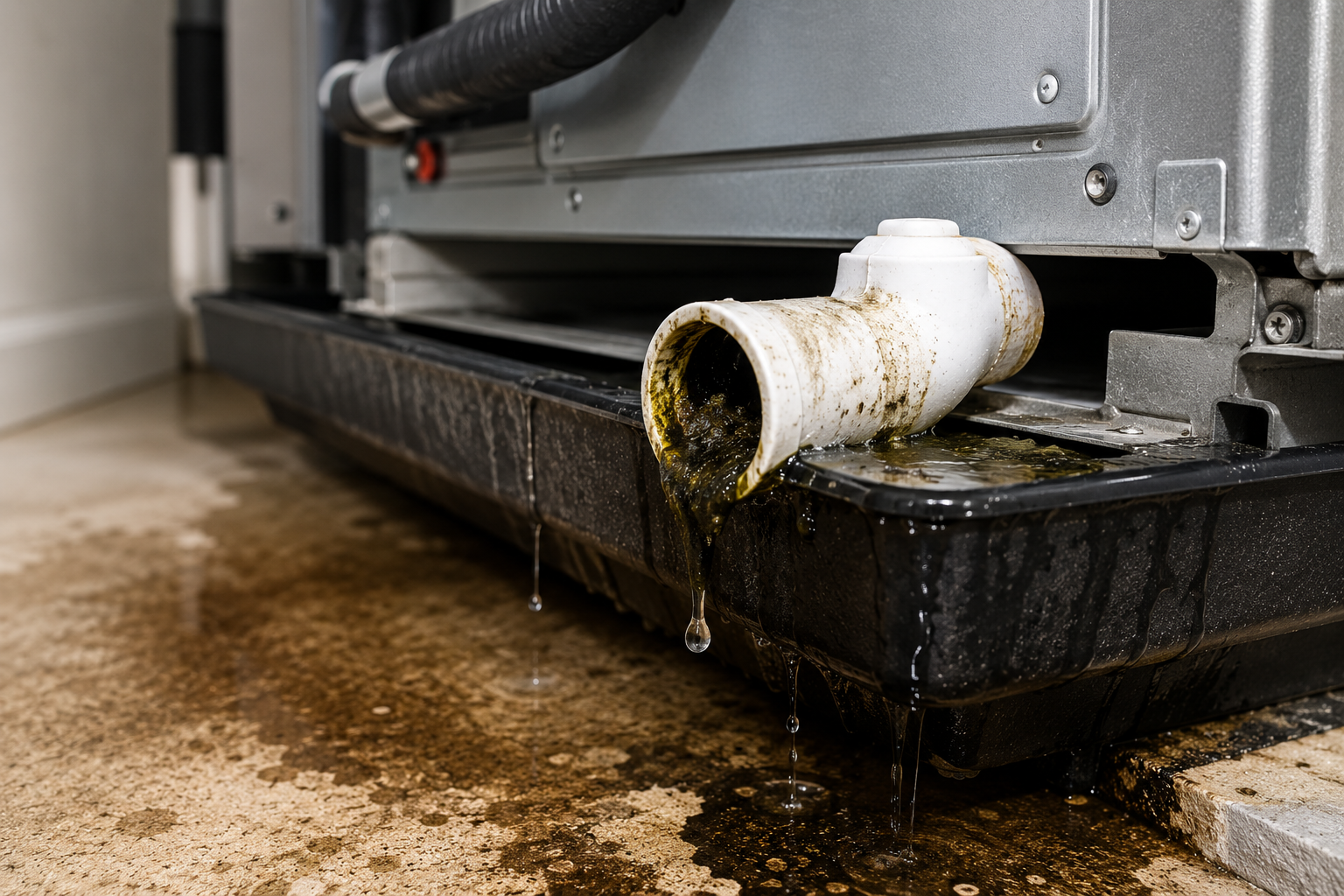
It's a plain piece of PVC pipe, usually three-quarters of an inch across, that carries the water your air conditioner pulls out of the air to somewhere outside your house. It has no moving parts. It costs almost nothing. And in a North Alabama summer, it is quietly handling several gallons of water a day — every day, for months.
When that pipe stops draining, the water doesn't stop coming. It just finds somewhere else to go.
Quick Answer
- What the symptom usually means: Your AC removes moisture from the air as it cools. That water collects in a pan under the indoor coil and drains out through a small PVC line. When that line clogs — almost always with biological slime — the pan fills, and the water backs up into your air handler, your ceiling, or your closet floor.
- Most likely causes (in plain language):
- Algae and bacterial slime growing in the constantly wet pan and line.
- A dirty evaporator coil shedding dust and debris into the pan.
- A drain line that sags or runs flat instead of sloping downhill.
- A missing, undersized, or dry P-trap that keeps the line from draining correctly.
- A blocked exterior termination — mud daubers, spiders, mulch, or dirt.
- Safe homeowner checks:
- Look at the floor and ceiling around your air handler for water, staining, or a swollen baseboard.
- Look in the secondary (emergency) drain pan under an attic air handler. It should be bone dry. Standing water there means the primary drain is already failing.
- Find the exterior termination — a small PVC stub, usually near the outdoor unit or under an eave — and confirm it's dripping during a humid day of runtime.
- If your AC shuts itself off but the thermostat still has power, a tripped condensate float switch is a very common cause.
- When to call a pro: Any time you see water where it doesn't belong, any time the emergency pan holds water, or any time the system shuts down on a float switch. Clearing the clog is the easy part. Finding out why it clogged — coil condition, line slope, trap design — is what keeps it from happening again next month.
What This Article Is About — and What It Is Not
This post is for homeowners dealing with water where it shouldn't be, or an AC that keeps shutting itself off, and who suspect the condensate drain is the culprit.
This is not an article about:
- A system that's running but the house won't get cool. If the air isn't cold, start with Why Is My AC Not Blowing Cold Air?.
- Visible ice on the coil or copper lines. That's a different failure with different causes — see Why Is My AC Frozen Up in the Summer?. (Worth knowing: a frozen coil that finally thaws can dump enough water at once to overwhelm a perfectly clean drain, so the two problems sometimes show up together.)
- A house that's cold enough but still feels damp and sticky. That's a humidity problem with its own diagnosis — see Why Your North Alabama Home Still Feels Humid With the AC Running.
If you're seeing water, staining, or a system that keeps tripping off, you're in the right place.
Where All That Water Comes From in the First Place
Cooling your house is only half of what your air conditioner does. The other half is dehumidification, and it's the part that produces the water.
Warm, humid air from your home passes across the indoor coil, which sits at roughly 40°F during normal operation. That surface is below the dew point of your indoor air, so moisture condenses on it — the same way a glass of ice water sweats on a July afternoon in Guntersville. The condensed water runs down the coil's fins into a drain pan underneath, and gravity carries it out through the condensate line.
The volume surprises people. In a humid North Alabama cooling season, a typical residential system can pull 5 to 20 gallons of water per day out of your indoor air, depending on system size, runtime, and how humid the house is. On a heavy day, that's a bathtub's worth of water passing through a three-quarter-inch pipe.
Two things follow from that:
- The pan and line are wet essentially all summer. They never dry out. That's a hospitable environment for biological growth.
- When the line stops flowing, the backup happens fast. Not over months — over hours.
The Warning Signs of a Clogged Condensate Drain Line
Clogs rarely announce themselves all at once. They usually build over weeks, and the signs escalate. Catching this early is almost entirely about knowing what to look for.
Early Signs (Before Any Water Shows Up)
- A musty or sour smell near the supply vents, especially in the first minute after the system kicks on. Standing water in the pan is exactly the kind of place biological growth takes hold, and your blower is moving air right past it.
- The exterior drain stub stops dripping. On a humid day with the system running, that little PVC pipe outside should be actively dripping or trickling. If it's dry during heavy runtime, the water is going somewhere else.
- The house feels a little more humid than it used to at the same thermostat setting. If the pan is holding standing water instead of draining, some of it re-evaporates back into your airstream. It's a subtle effect and rarely the only reason a house feels sticky — but it's a real one.
Obvious Signs (Water Is Already Moving)
- The system shuts itself off, but the thermostat still has power. This is the single most common way a clogged drain announces itself, and it's genuinely good news: it means a float switch did its job. That switch sits in the drain pan or the drain line, and when water rises past it, it cuts power to the system before the pan overflows. An AC that stops cooling in the middle of July is a lot cheaper than a ceiling.
- Standing water in the secondary (emergency) drain pan. Attic air handlers should sit in a large metal or plastic pan that catches overflow. That pan should be dry. Always.
- Water on the floor around the air handler, or a damp spot on the closet floor or garage slab underneath it.
- A gurgling or sucking sound at the drain, which often points to a trap problem rather than a solid clog.
Late Signs (Damage Has Already Started)
- A brown ring or sagging spot on a ceiling below an attic air handler.
- Swollen baseboard, buckled flooring, or a wet wall cavity near an interior closet unit.
- Visible mold growth on drywall, framing, or the air handler cabinet itself. At this point you're no longer dealing with a plumbing problem — you're dealing with a moisture and mold-risk problem, and it should be assessed as one.
- Rust streaks or corrosion on the bottom of the air handler cabinet, a sign the pan has been overflowing internally for a while.
What Actually Clogs a Condensate Drain Line, Ranked
Foundation venting isn't a stupid idea. It's a climate-specific idea, and North Alabama is not the climate it was designed for. Here are the reasons it underperforms here, roughly in the order of how often we find each one driving the problem.
1. Our Summer Air Is the Moisture Source, Not the Cure
What it is. Venting assumes outdoor air is drier than crawl space air. Whether that's true depends on dew point — the actual amount of water in the air, as opposed to relative humidity, which only tells you how full the air is at its current temperature.
Why it causes problems. Through a North Alabama summer, outdoor dew points commonly sit in the upper 60s to low 70s °F for weeks at a time. Meanwhile, the ground under your house holds temperature far more steadily than the air does — crawl space surfaces frequently sit in the mid-60s to low 70s °F even in August.
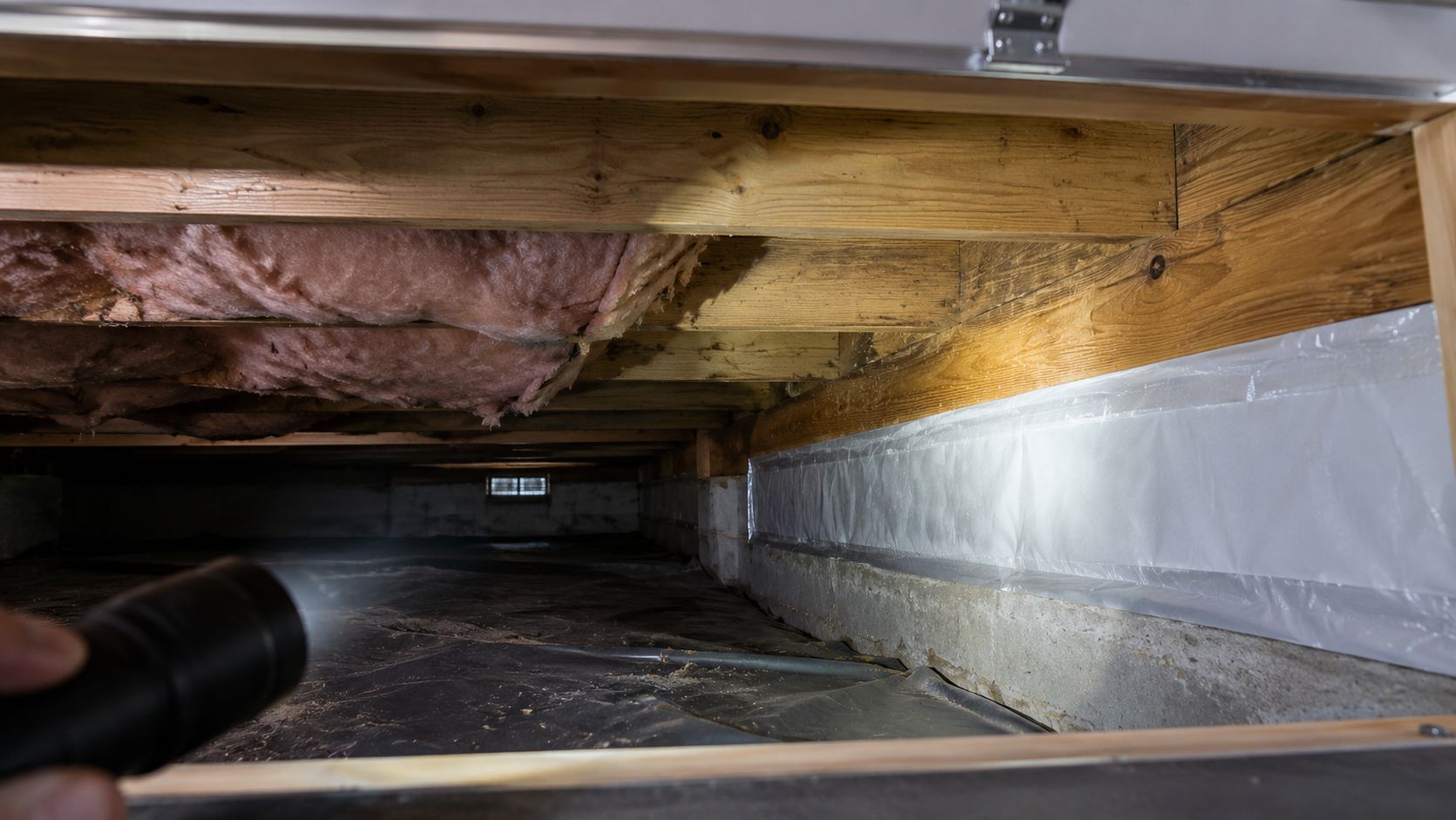
Run the numbers on what happens when you introduce one to the other. Take outdoor air at 92°F with a 74°F dew point — an ordinary July afternoon here. That air is around 56% relative humidity outside, which sounds fine. Now push it through a foundation vent into a crawl space where the surfaces are 70°F. The water content hasn't changed, but the temperature has. That same air is now at or above 100% relative humidity, and the excess has to go somewhere: onto the joists, the subfloor, the ductwork, and the pipes.
You are not ventilating the crawl space. You are irrigating it.
What should be measured or checked:
- Crawl space RH and temperature, logged continuously for several days, not a single spot reading. Target: below 60% RH.
- Outdoor dew point across the same period, for comparison.
- Wood moisture content in the floor joists and subfloor with a pin meter. Below 16% is where we want to be; sustained readings above 20% are where decay risk becomes a real concern.
More likely vs. less likely. This is more likely to dominate in June through September, in shaded or low-lying lots, and near water — homes around Lake Guntersville see a more extreme version of this, which we cover in Why Homes Near Lake Guntersville Have Worse Humidity Problems. It's less likely to be the whole story in a crawl space that's already well sealed from outdoor air but still reading damp, which usually points to the ground or a plumbing leak instead.
2. The Ground Under Your House Never Stops Evaporating
What it is. The indoor coil's fine aluminum fins collect a film of dust, pet dander, and skin cells that slip past the filter. That film gets wet every time the system runs, and pieces of it wash down into the drain pan.
Why it causes a clog. The coil is the source of the debris. A clean line above a filthy coil is a temporary condition — you're just waiting for enough material to wash down and re-plug it. This is why homeowners who have their drain "snaked" every summer keep having the same problem: the clog gets cleared, the source never does.
What should be measured or checked:
- Visual inspection of the coil, both faces if accessible.
- Static pressure across the coil, which rises as the coil loads up with debris.
- Filter history — a coil only gets dirty when the filter is undersized, bypassed, missing, or overdue.
More likely vs. less likely. More likely on systems older than about eight years with no documented coil cleaning, in homes that ran without a filter for any stretch, or after a renovation put drywall dust into the return. Less likely on a newer system with a properly sized, regularly changed filter.
Homeowner vs. pro: Pro work. Coil cleaning done wrong bends fins and can strip protective coatings. Choosing a filter that catches debris without choking airflow is a real balancing act — our guide on
choosing an HVAC filter for allergies and pollen covers the trade-offs.
3. Sagging, Flat, or Back-Pitched Drain Line
What it is. Condensate drains by gravity alone. The line needs a continuous downhill slope — the standard rule of thumb is a minimum of 1/8 inch of fall per foot of run (about a 1% grade). A line that runs flat, dips between hangers, or actually rises before it falls will hold water in the low spot.
Why it causes a clog. Water that sits doesn't clear. That standing pocket becomes the incubator for the slime described above and the collection point for any debris that washes down the line. Almost every chronic, repeat-clogging drain we find has a slope problem underneath it.
What should be measured or checked:
- The full run of the line traced from the air handler to the termination, checking for dips, sags between supports, and back-pitch.
- Support spacing — long horizontal runs of PVC in an attic need hangers every few feet or they will sag over time in the heat.
- Whether the line ever got rerouted around something (a new bathroom fan, added storage decking, a re-insulated attic).
More likely vs. less likely. More likely in attics, on long horizontal runs, in homes where the system was replaced and the old drain was reused, and on any system that clogs more than once a season. Less likely on short, well-supported runs with a clean drop.
Homeowner vs. pro: Pro work, and worth insisting on. Re-pitching a line permanently fixes the clogs that flushing only postpones.
4. A Missing, Wrong, or Dry P-Trap
What it is. A U-shaped bend in the drain line near the air handler. It looks like a plumbing trap, and it serves a related purpose — but the engineering behind it is specific to HVAC.
Why it causes a drainage problem. On most residential systems, the drain pan sits on the negative pressure side of the blower — the blower is pulling air through it. Without a properly sized trap, that suction pulls air up the drain line instead of letting water flow down it. The pan fills even though the pipe is completely clear. The trap has to be deep enough to hold a water seal against the blower's pressure; on a typical residential system that means a trap noticeably deeper than a shallow, decorative bend, sized to the system's static pressure.
Two related failures show up constantly:
- No trap at all, which lets the drain either fail to flow or blow conditioned air out the pipe.
- A dry trap during the off-season. In winter, the AC isn't producing condensate, the trap water evaporates, and the seal is broken until enough water accumulates in spring. That's why so many drain problems appear in the first hot week of the year.
What should be measured or checked:
- Whether a trap exists and whether it's on the correct side (draw-through vs. blow-through configuration).
- Trap depth compared to the measured static pressure at the air handler.
- Whether the line is vented after the trap.
More likely vs. less likely. More likely on systems installed quickly or by whoever was cheapest, on retrofits where the drain was reused, and on units where the drain never worked right from day one. Less likely on a carefully commissioned install with a documented trap.
Homeowner vs. pro: Pro work. Trap design is one of the most commonly botched details in residential HVAC, and it's not something to eyeball.
5. Blocked or Buried Exterior Termination
What it is. The end of the line, wherever it dumps outside. Mud daubers build nests in it. Spiders web it over. Mulch gets piled against it. Landscaping grows over it. Sometimes it was routed into a French drain or flower bed that's now full of dirt.
Why it causes a clog. A blocked outlet backs up the entire line no matter how clean the rest of it is. This one is the most satisfying to find because it's the easiest to fix.
What should be measured or checked:
- Locating the termination and confirming it's open and above grade.
- Whether it drips during runtime on a humid day.
- Whether it terminates somewhere sensible — not against the foundation, not into a crawlspace, and not where it dumps gallons a day next to your footing.
More likely vs. less likely. More likely in homes with heavy landscaping near the termination, in spring after nesting season, and on lines that terminate low near mulch beds. Less likely on a clearly visible stub above a hard surface.
Homeowner vs. pro: Homeowner-doable to inspect and clear an obvious nest. Relocating a badly routed termination is pro work — especially if it's currently draining into a crawlspace, which is a moisture problem waiting to happen.
6. Rust, Debris, and Failing Pans
What it is. On older systems with metal drain pans, corrosion flakes off into the water and collects in the line. Insulation fragments, construction debris left in the cabinet, and pieces of a deteriorating pan do the same. A rusted-through pan can also leak around the drain entirely, which mimics a clog without being one.
Why it causes a clog. Hard debris settles at the trap or at the first elbow and creates a dam that slime then builds on.
What should be measured or checked:
- Physical inspection of the primary pan for rust-through, cracks, or standing debris.
- Whether the water is leaking from the pan itself rather than backing up out of it.
- The age and condition of the coil assembly overall.
More likely vs. less likely. More likely on systems over 12–15 years old, and on any unit already showing corrosion at the cabinet base. Less likely on modern systems with molded plastic pans.
Homeowner vs. pro: Pro work. A failed pan on an aging coil is often a point where repair-versus-replace deserves an honest conversation.
How to Prevent a Clogged Condensate Drain Line
Prevention here is unusually effective. Unlike a lot of HVAC problems, this one responds well to a short list of simple, repeatable habits.
The Homeowner Checklist
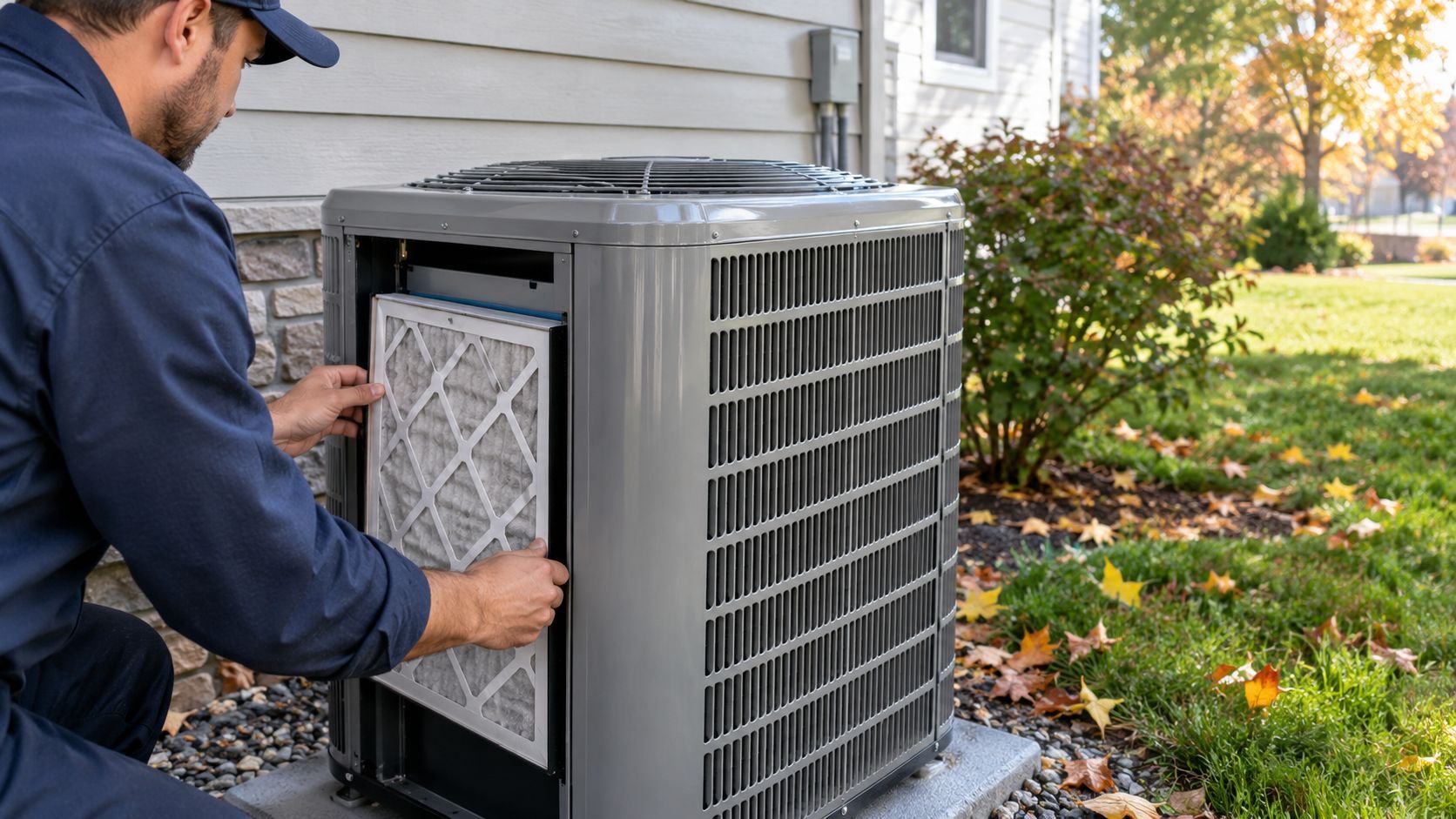
- Change your filter on schedule. Everything that gets past the filter eventually ends up on the coil, and everything on the coil eventually washes into the pan. In North Alabama's pollen season, a 1-inch filter often needs changing every 30–60 days, not once a year. Our guide on how often to change your HVAC filter has the specifics.
- Check the exterior termination twice a season. Once at the start of cooling season, once mid-summer. It should be open, clear of mulch and nests, and dripping when the system has been running on a humid day.
- Look at the emergency pan when you change the filter. If your air handler is in the attic, glance into the secondary pan while you're up there. Dry is normal. Any standing water means the primary drain is already failing and you should get it addressed before it overflows.
- Flush the line at the cleanout once a month during cooling season. Most systems have a capped tee near the air handler. Pour about a cup of distilled white vinegar down it, let it sit 20–30 minutes, then follow with a slow flush of warm water. Vinegar is the safer routine choice — bleach is harsher on metal pans, drain fittings, and any adjacent equipment.
- Keep landscaping off the termination. A foot of clearance is plenty.
What not to do: Don't blow compressed air blindly into the drain line. It can push the clog backward into the pan, and on older systems it can separate a glued joint inside a wall or ceiling — turning a small problem into a much larger one. Don't remove or bypass a float switch to get the system running again; that switch is the only thing standing between a clog and your drywall.
What Belongs on a Professional Maintenance Visit
A maintenance visit that doesn't touch the condensate system isn't a real maintenance visit in this climate. At minimum, expect:
- A vacuum clearing of the drain line from the exterior termination, not just a flush from above.
- Inspection and cleaning of the primary drain pan, including removing standing debris.
- A coil inspection — the actual source of the material that clogs the line.
- Float switch testing, by physically raising the float and confirming the system shuts down.
- A check of line slope and trap condition on any system with a history of repeat clogs.
- Static pressure measurement, which flags a loading coil before it starts feeding the pan.
Catching a marginal drain before it backs up is exactly the kind of thing a
maintenance membership is for. It's a small, unglamorous item on a checklist that quietly prevents ceiling repairs.
Upgrades Worth Making Once
Some fixes are one-time and permanent:
- Install a float switch if you don't have one. If your air handler sits in an attic above finished space and there's no float switch, this is the highest-value, lowest-cost safety device in your entire system. Ideally you'd have both a pan switch in the secondary pan and an inline switch on the primary drain.
- Re-pitch or reroute a sagging line. Fixes chronic clogging at the source instead of managing it annually.
- Add a proper cleanout tee near the air handler if there isn't one, so future flushing is simple.
- Correct trap design if the drain has never flowed right.
- Insulate the drain line where it runs through unconditioned space. In a hot, humid attic or a vented crawlspace, a line carrying 55°F water will sweat on the outside and drip — which looks exactly like a leak and creates its own moisture problem. If your ducts and drain run through a damp vented crawlspace, that's a bigger conversation: see vented vs. encapsulated crawl spaces in Alabama.
- Relocate a termination that dumps into a crawlspace or against the foundation. Twenty gallons a day next to your footing is not a small thing.
Why North Alabama Homes Clog More Often Than Most
A few specifics about our climate and our housing stock make this a bigger issue here than in a drier region:
- A long, humid cooling season. Systems in Huntsville and Madison run for months, which means the pan and line are continuously wet from roughly April through October. Biological growth needs moisture and time, and we supply both generously.
- Air handlers in attics, over finished ceilings. A huge share of homes around Huntsville put the air handler and its drain pan directly above living space. That geometry turns a $150 drain clog into a drywall, insulation, and paint job.
- Air handlers in vented crawlspaces. In Arab, Guntersville, and Albertville, plenty of homes put the equipment in a vented crawlspace where summer humidity routinely runs high. High humidity around the cabinet means more sweating on uninsulated lines, more moisture in the space, and a damper environment for growth.
- Heavy pollen loads. Our springs load filters and coils fast. Every bit of that organic material that gets past the filter is future food for slime in the drain pan.
- Long horizontal drain runs. Homes with the air handler in the center of an attic often have 20–40 feet of PVC to get outside. Long runs sag in attic heat, and every sag holds water.
None of this means a clog is inevitable. It means the maintenance interval that works fine in a dry climate is not enough here.
How a Good Contractor Should Diagnose a Condensate Problem
Anybody can clear a clog. The question that matters is why it clogged, because that's what determines whether you're doing this again in six weeks.
A thorough condensate diagnostic should include:
- Confirming the source of the water. Backed-up pan, cracked pan, sweating uninsulated line, and a thawing frozen coil all produce water in similar places and are fixed very differently.
- Clearing the line from the termination end with a wet/dry vacuum, then verifying free flow with a measured volume of water poured into the pan.
- Physical inspection of the primary pan and the coil above it, with panels off. If the coil is dirty, the clog will come back.
- Tracing the full drain run for slope, sags, support spacing, and back-pitch.
- Evaluating trap presence, depth, and configuration against the measured static pressure of the system.
- Testing every float switch by raising the float and confirming shutdown.
- Measuring static pressure and temperature split at the air handler — a system with restricted airflow makes a colder coil, which makes more condensate and gets closer to freezing, which stresses the drain further.
- Assessing moisture damage to surrounding drywall, framing, insulation, or subfloor if water has been escaping for a while.
If the answer is a straightforward clog on an otherwise healthy system, that's an HVAC repair visit — clear it, clean the pan, verify flow, done. If the drain has clogged repeatedly, if there's a history of water damage, or if the drain problem sits alongside a broader humidity, musty-odor, or comfort story in the house, a Home Comfort Consult is the more appropriate path. It looks at the whole system — coil condition, airflow, duct layout, crawlspace and attic conditions, and the building itself — and produces a written, ranked plan rather than a repeat visit every summer.
When to Act — and What Happens If You Wait
A clogged condensate line isn't dangerous in the way a gas leak is. But it's one of the fastest ways a small HVAC problem becomes a building problem:
- Water damage to finished space. An overflowing pan above a ceiling doesn't need long to stain drywall, soak insulation, and swell trim. Repair costs here routinely exceed the cost of the HVAC work by a wide margin.
- Moisture and mold risk. Wet drywall, wet framing, and wet insulation in a humid climate create conditions where microbial growth can take hold. We're not going to tell you exactly what that will or won't do to anyone's health — that's not our lane, and anyone promising you certainty there is overselling. What we will say plainly: chronic moisture inside a building assembly is a problem worth fixing promptly, on its own merits.
- Air quality concerns from the pan itself. Your blower moves air past that pan every cycle. A pan with standing water and biological growth can be the source of a persistent musty smell in the house. Cleaning it up may help reduce a known source of odors and airborne particles — though we'd stop short of promising how any individual will feel afterward.
- Corrosion and equipment damage. Chronic overflow rusts out cabinet bases, drips onto control boards, and shortens the life of an expensive piece of equipment.
- Repeat downtime. Every float-switch trip is a hot house until someone gets out there. In the middle of a Huntsville August, that's not a minor inconvenience.
There's also a modest secondary efficiency angle — a system with a clean coil and a properly draining pan does its dehumidification work with less runtime. We mention it last on purpose. The reason to fix a condensate problem is to protect your house, not to chase a number on a power bill.
Getting a Straight Answer About the Water in Your Home
If you've found water around your air handler, standing water in the emergency pan, or your system keeps shutting off on a float switch, don't just clear it and hope. A HVAC repair visit is the right fit when it's a single, well-defined clog — you'll get it cleared, the pan cleaned, flow verified, and a clear explanation of what caused it.
If this has happened more than once, if there's already water damage, or if the drain problem is one piece of a bigger humidity or musty-odor story in your house, the Home Comfort Consult takes the whole system apart on paper — coil, airflow, drain design, crawlspace, and building conditions — and gives you a ranked written plan. For homeowners whose main concern is the air itself, the Home Air Health Study adds a week of indoor air monitoring and carries our Breathe-Easy Clarity Guarantee: if at the end of the review you don't feel clear on what's going on in your home and what to do next, you don't pay.
No guesswork, no annual re-clogging, no mystery stain on the ceiling.
Schedule an HVAC Repair Visit →
Learn about the Home Comfort Consult →
Frequently Asked Questions
How do I know if my AC drain line is clogged?
The most common signal is the system shutting itself off while the thermostat still has power — that's usually a float switch responding to a rising water level. Other signs, roughly in order of severity: the exterior drain stub isn't dripping during humid runtime, a musty smell when the system kicks on, standing water in the secondary drain pan under an attic unit, water on the floor around the air handler, and finally a brown ring or sag in the ceiling below. If you see standing water in the emergency pan, treat it as an active problem even if nothing has overflowed yet.
Can I unclog my AC drain line myself?
You can often clear a simple clog. The safest homeowner method is to attach a wet/dry vacuum to the exterior termination and run it for a minute or two to pull the blockage out from the downstream end, then flush from the cleanout tee near the air handler to verify flow. Avoid blowing compressed air into the line — it can push the clog backward into the pan or separate a glued joint hidden in a wall. And if the line clogs again within a few weeks, stop clearing and start diagnosing; a repeat clog almost always means a dirty coil, a sagging line, or a trap problem underneath it.
Should I use bleach or vinegar in my AC drain line?
For routine maintenance, distilled white vinegar is the safer choice. Roughly a cup at the cleanout, monthly during cooling season, left to sit 20–30 minutes and then flushed with warm water. Bleach is harsher on metal drain pans, fittings, and nearby components, and the fumes can be pulled into the return air path. Neither is a substitute for physically cleaning the pan and coil — chemical treatment slows regrowth, but it doesn't remove buildup that's already established.
Why does my AC drain line keep clogging every year?
Repeat clogging is a design or source problem, not a bad-luck problem. The three usual culprits: a dirty evaporator coil that keeps feeding debris into the pan, a drain line that sags or runs flat somewhere along its route and holds standing water, or a missing or incorrectly sized P-trap that prevents proper flow. Clearing the line addresses the symptom; correcting the coil condition, the line slope, or the trap is what actually stops the cycle. If you've had this cleared more than twice, ask specifically for the line to be traced for pitch and the trap to be evaluated against measured static pressure.
How much water should my AC drain produce?
More than most people expect. In a humid North Alabama cooling season, a typical residential system commonly removes somewhere between 5 and 20 gallons per day, varying with system size, runtime, and indoor humidity. On a very humid day with long runtime, a steady trickle at the exterior termination is completely normal and healthy. A drain that produces nothing during heavy runtime on a muggy day is the one to worry about — the water is still being made, it's just going somewhere else.
About the Author
Tanner Dickerson is the owner of Dickerson Services, a North Alabama HVAC, home performance, and crawl space encapsulation company serving Huntsville, Madison, Arab, Guntersville, Albertville, and the surrounding area. He works with homeowners on complex comfort, humidity, and indoor air quality problems by treating the whole house as a system — HVAC, ducts, crawlspace, air sealing, insulation, and ventilation together.
Climate and Plant Selection
Selecting appropriate vegetation is crucial for the success of green roofs in the Mid-Atlantic region. Native and drought-tolerant plants are ideal, ensuring survival during dry spells and high-intensity storms. Sedums, grasses, and other hardy species maintain runoff retention and resist seasonal stress, supporting regulatory compliance throughout the year.

Share this article