
Vented vs. Encapsulated Crawl Spaces in Alabama: Which One Belongs Under Your House?
July 31, 2026
What it is. A thermostat mounted where it doesn't sense the true average temperature of the home — in direct afternoon sun, on an exterior wall, near a sunny window, or above a heat-producing appliance.
Why it causes this symptom. A thermostat only knows the temperature at its own spot on the wall. If the afternoon sun lands on it, or it sits on a wall that heat-soaks late in the day, it reads warmer than the rest of the house and keeps calling for cooling it may never feel "satisfied" delivering — so the system runs and runs without ever clicking off. It can also work the other way, where a poorly placed thermostat shuts the system off early and lets distant rooms drift. Either way, the thermostat's afternoon reading is part of the story even when the equipment is healthy.
What should be measured or checked:
- A second thermometer placed in the main living area, compared against what the thermostat reports.
- Whether sun ever falls directly on the thermostat during the afternoon.
- Thermostat location relative to supply registers, exterior walls, and appliances.
More likely vs. less likely. More likely if the thermostat is on a sunny wall, near a window, or in a spot that clearly feels different from the rest of the house. Less likely if it sits on a shaded interior wall and matches a handheld thermometer.
Homeowner vs. pro:
Comparing the thermostat to a separate thermometer is an easy homeowner check. Relocating a thermostat is a small pro job, and worth doing only after the bigger capacity and load questions are ruled out.
If your house sits over a crawl space in Arab, Guntersville, or one of the older neighborhoods around Huntsville, you have almost certainly been told two opposite things by two different people.
One says the vents are there for a reason and closing them will trap moisture and rot your floor. The other says the vents are the whole problem and you should seal the space up, cover the dirt, and put a dehumidifier down there.
They can't both be right. And in North Alabama's climate, the answer is less debatable than the arguments make it sound — though it isn't a blanket "always encapsulate," either.
This article explains what each approach actually does, why the physics of our summers matters so much, when venting is still the correct choice, and what a contractor should measure before recommending either one.
Quick Answer
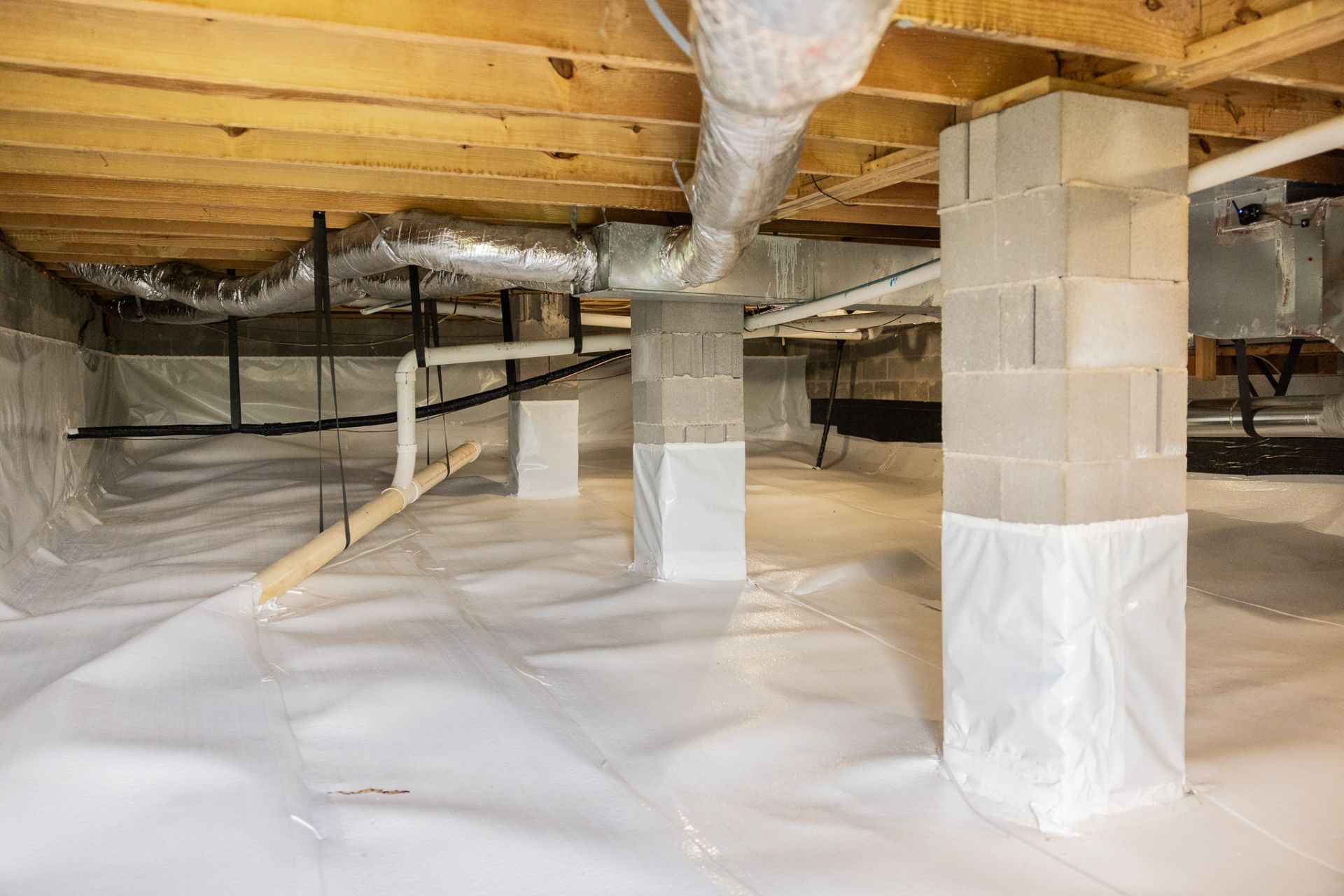
- What the two approaches are: A vented crawl space is open to outdoor air through foundation vents, with insulation (usually fiberglass batts) between the floor joists. An encapsulated crawl space is sealed off from outdoor air and ground moisture with a heavy-duty vapor barrier over the dirt and up the walls, insulation moved to the foundation walls, and the space kept dry with a dehumidifier or a small supply of conditioned air.
- Why venting struggles here: Foundation venting was designed to dry a crawl space with outside air. That works when the outside air is drier than the crawl space. In a North Alabama summer, outdoor dew points routinely sit in the upper 60s to low 70s °F while crawl space surfaces sit in the 60s — so venting adds moisture to the space instead of removing it. This is the single most common driver of the 80–95% crawl space relative humidity readings we log under local homes.
- The most common signs a vented crawl space isn't working:
- Musty odor in the house, strongest near floor registers or on the lowest level
- Fiberglass insulation sagging or fallen off the floor joists
- Sweating ducts, damp or rusted duct boots, condensation on pipes
- Cupping hardwood floors, sticking doors, or a "cool but clammy" feel downstairs
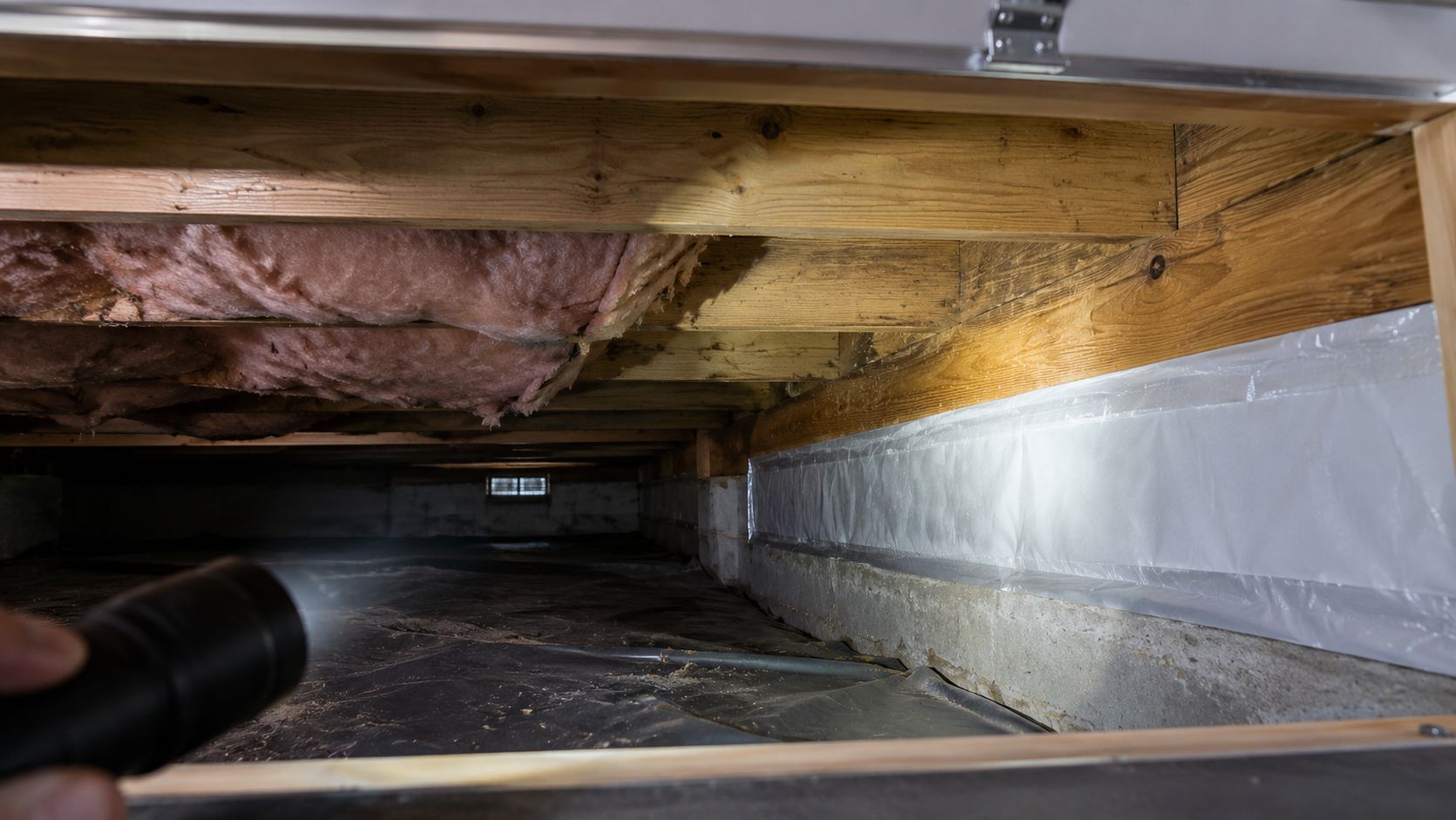
- Safe homeowner checks: Put a $15–$25 hygrometer in the crawl space for a week. Sustained readings above 60% RH mean the space isn't drying. Take a flashlight down and look for standing water, black or white growth on the joists, fallen insulation, and dirt-streaked corners where air is leaking in.
- When to call a pro: Before spending money on either approach. Encapsulation is a significant investment and it can go wrong — the correct decision depends on measured crawl space RH and temperature over several days, wood moisture content in the floor framing, duct leakage, grading and drainage, and whether the home has combustion appliances down there. A contractor who quotes encapsulation without measuring any of that is guessing.
Who This Decision Is For — and What This Article Is Not
This is written for homeowners with an existing crawl space foundation who are deciding what to do with it — either because something is already wrong (musty smell, damp floors, visible mold, a bad home inspection report) or because they are planning other work and want to get this right once.
This article is not:
- A guide to fixing active water intrusion. If water runs into your crawl space after a storm, or you have a plumbing leak, that has to be corrected first. No vapor barrier and no dehumidifier will out-run a hole. Grading, gutters, downspout extensions, and drainage come before any of this.
- A structural repair guide. If joists are visibly rotted, if piers have settled, or if you can push a screwdriver into the framing, that's a structural conversation with a qualified contractor before anything gets sealed up.
- A mold remediation article. If there is significant visible growth, testing and remediation are their own scope. Encapsulation removes the conditions that allow growth; it doesn't clean up what's already there.
- A promise about anyone's health. We'll talk honestly about moisture, odors, and air quality, but we don't claim that fixing a crawl space treats or cures any medical condition. That is a question for a physician.
If your question is broader — "what should my indoor humidity even be?" or "why does my house feel humid with the AC running?" — two companion articles cover those directly:
What Should Indoor Humidity Be in a North Alabama Home? and
Why Your North Alabama Home Still Feels Humid With the AC Running.
What Each Type Actually Is
Before comparing them, it's worth being precise, because "encapsulation" gets used loosely — sometimes to describe a job that's really just a plastic sheet thrown over the dirt.
The Vented Crawl Space
This is the traditional assembly and still the most common one under older North Alabama homes:
- Dirt floor, sometimes with a thin plastic sheet laid loosely over it, often with nothing at all.
- Foundation vents cut through the block walls around the perimeter.
- Insulation between the floor joists, almost always fiberglass batts, held up by wire rods or netting.
- The crawl space is treated as "outside" — so ducts, water lines, and sometimes the air handler live in unconditioned space.
Building code has long recognized this assembly. Under the International Residential Code (Section R408.1), a vented crawl space needs at least 1 square foot of net vent opening for every 150 square feet of crawl space floor area — or, if the ground is covered with a Class I vapor retarder, that requirement drops to 1 square foot per 1,500 square feet. That reduction is itself a hint: the code recognizes that covering the dirt does far more for moisture control than the vents do.
The logic behind venting is straightforward and, in the right climate, sound: ground moisture evaporates into the crawl space, and outdoor air flushes it away.
The Encapsulated (Sealed) Crawl Space
An encapsulated crawl space flips the assembly. Instead of treating the crawl space as outdoors, it brings it inside the home's thermal and air barrier:
- Foundation vents are sealed shut and the space is closed off from outdoor air.
- A continuous heavy-duty vapor barrier covers the entire dirt floor, is overlapped and taped at the seams, and runs up the foundation walls and piers, sealed to them.
- Insulation moves from the floor joists to the foundation walls and the rim/band joist — usually closed-cell spray foam, rigid foam board, or a hybrid of the two.
- The space is dried and kept dry, either with a dedicated crawl space dehumidifier or a small supply of conditioned air from the HVAC system.
Code recognizes this assembly too. IRC Section R408.3 permits an unvented crawl space where the exposed earth is covered with a continuous Class I vapor retarder with joints overlapped 6 inches and sealed or taped, extending at least 6 inches up the stem wall and sealed to it — plus one of two mechanical provisions: continuously operated mechanical exhaust at 1 CFM per 50 square feet of crawl space floor area, or conditioned air supply at 1 CFM per 50 square feet with a return pathway back to the house, along with insulated perimeter walls.
In practice, for our climate, we generally favor a dedicated dehumidifier over either mechanical option, because a dehumidifier controls the variable that actually matters — moisture — rather than trying to control it indirectly with airflow.
A note on terminology: a properly done encapsulation is a
five-step job — remove debris and old insulation, level the floor, install and seal the vapor barrier, seal joints and piers, insulate the walls and rim joists. Laying plastic on dirt and calling it encapsulation is not the same product, and it will not produce the same result.
Why Venting Works on Paper and Struggles in Alabama, Ranked
Foundation venting isn't a stupid idea. It's a climate-specific idea, and North Alabama is not the climate it was designed for. Here are the reasons it underperforms here, roughly in the order of how often we find each one driving the problem.
1. Our Summer Air Is the Moisture Source, Not the Cure
What it is. Venting assumes outdoor air is drier than crawl space air. Whether that's true depends on dew point — the actual amount of water in the air, as opposed to relative humidity, which only tells you how full the air is at its current temperature.
Why it causes problems. Through a North Alabama summer, outdoor dew points commonly sit in the upper 60s to low 70s °F for weeks at a time. Meanwhile, the ground under your house holds temperature far more steadily than the air does — crawl space surfaces frequently sit in the mid-60s to low 70s °F even in August.
Run the numbers on what happens when you introduce one to the other. Take outdoor air at 92°F with a 74°F dew point — an ordinary July afternoon here. That air is around 56% relative humidity outside, which sounds fine. Now push it through a foundation vent into a crawl space where the surfaces are 70°F. The water content hasn't changed, but the temperature has. That same air is now at or above 100% relative humidity, and the excess has to go somewhere: onto the joists, the subfloor, the ductwork, and the pipes.
You are not ventilating the crawl space. You are irrigating it.
What should be measured or checked:
- Crawl space RH and temperature, logged continuously for several days, not a single spot reading. Target: below 60% RH.
- Outdoor dew point across the same period, for comparison.
- Wood moisture content in the floor joists and subfloor with a pin meter. Below 16% is where we want to be; sustained readings above 20% are where decay risk becomes a real concern.
More likely vs. less likely. This is more likely to dominate in June through September, in shaded or low-lying lots, and near water — homes around Lake Guntersville see a more extreme version of this, which we cover in Why Homes Near Lake Guntersville Have Worse Humidity Problems. It's less likely to be the whole story in a crawl space that's already well sealed from outdoor air but still reading damp, which usually points to the ground or a plumbing leak instead.
2. The Ground Under Your House Never Stops Evaporating
What it is. Bare soil in a crawl space is a continuous moisture source. Water moves up through the earth and evaporates into the space, day and night, year-round. A common industry rule of thumb puts this at roughly 10–15 gallons of water per 1,000 square feet of exposed dirt per day under typical conditions — enough that no amount of passive venting keeps up.
Why it causes problems. The vapor has to go somewhere. Some leaves through the vents. A lot of it condenses on the coolest surfaces available, and a meaningful share of it rises into the house through the floor. This is the moisture load your air conditioner ends up fighting upstairs — which is why crawl space work is so often the actual answer to a "my house feels humid" complaint.
What should be measured or checked:
- Existing vapor barrier coverage and condition — is there one, does it cover everything, are the seams sealed, does it run up the walls and piers, or is it a torn sheet with two feet of bare dirt around the perimeter?
- Standing water, damp soil, and efflorescence (white mineral crust) on the block walls, which indicates water moving through the foundation.
- Grading and drainage outside: does the earth slope away from the house, do downspouts discharge well away from the foundation?
More likely vs. less likely. More likely on homes with exposed dirt, older homes with no barrier at all, and lots with poor drainage or a high water table. Less likely to be the primary driver where a properly sealed barrier is already installed — though we still check, because barriers get torn by plumbers, pest technicians, and HVAC crews years after installation.
Homeowner vs. pro: The flashlight inspection is homeowner-friendly. Correcting drainage, leveling the floor, and installing a sealed barrier is pro work.
3. Wet Goes to Cold — Condensation on Ducts, Pipes, and Framing
What it is. One of the more useful rules in building science: moisture is drawn to cold surfaces, and when a surface drops below the dew point of the surrounding air, water condenses on it. It's why a glass of iced tea sweats in July.
Why it causes problems. In a vented crawl space, the coldest surfaces available in summer are your supply ducts — carrying roughly 55°F air — and your cold water lines. Humid crawl space air at a 72°F dew point hitting a 55°F duct produces liquid water on the duct, on the duct boots, on the insulation wrapping, and eventually on the framing and subfloor above.
This is the mechanism behind a lot of complaints that seem unrelated: rusted duct boots, water stains on the subfloor, cupped hardwood in one room, a musty smell that comes on when the AC runs. It's also why sealing ducts in a vented crawl space is described in the air sealing literature as critical — those ducts are outside the home's envelope, and every leak both loses conditioned air and pulls damp crawl space air into the system.
What should be measured or checked:
- Visual inspection of ducts and boots for condensation, rust, sagging, and separated joints.
- Duct leakage testing (Duct Blaster or pressure pan), and static pressure at the air handler. Important caveat: sealing ducts raises system static pressure, so the system should be verified below roughly 0.5" water column on high fan speed before a sealing job, or you can shorten the life of the equipment.
- Surface temperatures with an infrared thermometer or thermal camera, compared against the crawl space dew point.
More likely vs. less likely. More likely where the ductwork is in the crawl space (very common here) and the space is vented. Less likely where ducts are inside conditioned space or the crawl space is already dry.
Homeowner vs. pro: You can look for rust and condensation. Static pressure testing, duct leakage testing, and any sealing work is pro-only — and the order of operations matters.
4. Fiberglass Batts Between the Floor Joists Fail Predictably
What it is. The standard vented-crawl-space insulation strategy is fiberglass batts pushed up between the floor joists. In a humid crawl space, this assembly has a poor track record.
Why it causes problems. Two reasons. First, fiberglass is not an air barrier — air moves right through it, so it slows heat transfer but does nothing to stop humid crawl space air from reaching the subfloor. Second, it absorbs and holds moisture. Damp batts get heavy, lose R-value, sag away from the subfloor, and eventually fall. Once there's an air gap between the batt and the floor above, the insulation has stopped doing its job entirely. And because fiberglass tends to trap moisture against wood, it can make conditions at the subfloor worse rather than better.
Fallen insulation is usually the first thing a homeowner notices when they finally go down there — and it's a symptom, not the disease.
What should be measured or checked:
- Physical condition of the batts: sagging, fallen, discolored, compressed, or missing.
- Wood moisture content of the subfloor directly above any damp insulation.
- Whether the batts are even in contact with the subfloor — gaps make them close to useless.
More likely vs. less likely. More likely in any vented crawl space more than 10–15 years old in our climate. Less likely to matter in a crawl space that's being encapsulated anyway, since the batts come out and the insulation moves to the walls.
Homeowner vs. pro: Looking is homeowner work. Removing wet, potentially mold-affected insulation is pro work with proper protection.
5. Your Crawl Space Is Connected to Your Living Space Whether You Like It or Not
What it is. Homeowners tend to think of the crawl space as a separate outdoor area. Physically, it isn't. Air moves between the two constantly through the stack effect — warm air rising and escaping at the top of the house, pulling replacement air in at the bottom — plus plumbing penetrations, duct chases, wiring holes, and the rim joist.
Why it causes problems. Estimates vary by house, but a substantial fraction of the air you breathe on the first floor started in the crawl space. If that space is at 85% RH over damp dirt with fallen insulation and a musty odor, that's the air being drawn upward into the house. It's the reason the smell in the living room and the condition of the crawl space are the same problem.
It's also why crawl space work belongs in the same conversation as HVAC work. The rim joist is described in the air sealing literature as the intake for the winter stack effect, and the path that lets cool air out and humidity in during the summer. Sealing the top and bottom of a house is the highest-leverage air sealing there is.
What should be measured or checked:
- A blower door test for whole-home air leakage, ideally with zonal pressure diagnostics to quantify how connected the crawl space is to the living space.
- Indoor RH logged alongside crawl space RH, to see whether the two track each other.
- Rim joist and penetration condition — dirt-streaked corners are a reliable visual sign of air leakage.
More likely vs. less likely. More likely in taller homes (stronger stack effect), leaky homes, and homes with return duct leaks in the crawl space. Less likely in a tight, single-story home with sealed ductwork — but "less likely" is not "not happening."
Homeowner vs. pro: Blower door and zonal pressure testing are pro-only.
What Encapsulation Actually Involves — and What It Isn't
Done properly, encapsulation is a sequence, and skipping steps is where jobs go wrong.
1. Remove debris and old insulation. Out come the fallen fiberglass batts, construction leftovers, rocks, and anything organic. This is dirty, uncomfortable work and it's the step most often shortchanged.
2. Level the floor. Rocks and ruts puncture and tent a vapor barrier. The floor gets smoothed so the barrier lies flat and stays intact.
3. Install the vapor barrier. A continuous Class I vapor retarder over the entire floor, with seams overlapped generously — 12 to 24 inches is a common spec — and run 8 to 12 inches up the foundation walls. Code requires a minimum 6-inch overlap and 6 inches up the stem wall; good practice exceeds both.
4. Seal joints and piers. Every seam gets taped. The barrier runs 8 to 16 inches up each pier and is caulked, foamed, or taped to it. This is what separates real encapsulation from plastic on dirt.
5. Insulate the walls and rim joists. Three approaches, in rough order of effectiveness: closed-cell spray foam (best results, easiest to get right, most expensive, requires a pro), rigid foam board (more DIY-friendly, harder to seal well), or a hybrid — foam board on the walls with spray foam at the rim joists, which handles the hardest part properly. Fiberglass is not on this list, for the reasons above.
6. Control the humidity. The space needs a way to stay dry: a properly sized crawl space dehumidifier, or a conditioned air supply with a return pathway per code. Sealing a crawl space without addressing moisture removal is the one version of this job that genuinely can make things worse — and it's the legitimate kernel of truth in the "don't close your vents" warning.
Two things encapsulation is not:
- It is not a substitute for drainage. If water enters the crawl space, it needs to be managed with grading, gutters, downspout extensions, and where warranted, interior drainage and a sump. Sealing over a wet problem doesn't solve it.
- It is not a DIY vapor barrier from the home improvement store. The 6-mil plastic sold for general use is not the same material, and unsealed seams and unsealed piers leave most of the ground open to the space.
A safety item worth stating plainly: if there are combustion appliances in the crawl space — a gas water heater or furnace with an atmospheric draft — sealing the space changes the air available for combustion and venting. That situation requires a combustion safety evaluation before anything gets sealed. Don't let anyone skip it.
When a Vented Crawl Space Is Still the Right Call
We encapsulate a lot of crawl spaces. We don't think every crawl space in North Alabama needs it, and we'd rather say so than sell you something.
Cases where staying vented — and improving what's there — is reasonable:
- The crawl space is already dry and stable. If logged RH stays under 60% through the summer, wood moisture content is under 16%, there's no odor, and the ducts aren't sweating, the assembly is working. Cover the dirt with a good sealed vapor barrier, fix the drainage, seal the ducts, and monitor it. That's a fraction of the cost of full encapsulation.
- Active water intrusion hasn't been solved yet. Drainage first. Always.
- Structural or pest issues need attention first. Encapsulation covers the ground, which changes what a termite inspector can see. Coordinating with your pest control company — and often leaving an inspection gap at the top of the barrier — matters, and some homes need structural repair before anything else happens.
- The budget is limited and the crawl space isn't the biggest problem. If your real complaint is a 12-degree upstairs temperature difference, the crawl space may not be the highest-value place to spend first. We'd rather sequence the work by impact than sell the most expensive item on the menu. (If that's your situation, Why Is the Upstairs Hotter Than the Downstairs? is the more relevant read.)
- There are unresolved combustion appliances down there. Until that's addressed, sealing isn't safe.
The honest framing: encapsulation is the better assembly for our climate in most cases, but "better assembly" and "your highest-priority project this year" are different questions.
North Alabama and Local Construction Factors
Several things about our region make this decision play out differently than it would in Denver or Minneapolis.
- We're a mixed-humid climate — IECC Climate Zone 3A across most of North Alabama. Long, humid cooling seasons and mild winters. The moisture load runs in one dominant direction for most of the year, and that direction is into the building.
- Summer dew points stay high for months, not days. From June into September, dew points in the upper 60s and low 70s °F are routine. That's not a heat wave — that's the baseline your crawl space lives in.
- A lot of local housing stock predates modern moisture practice. Homes in Arab, Albertville, Guntersville, and the older neighborhoods around Huntsville were largely built when a vented crawl space with fiberglass batts was simply standard. Newer Huntsville and Madison subdivisions skew toward slab-on-grade, which sidesteps this issue entirely — one reason the crawl space conversation clusters in specific parts of the market.
- Ductwork lives in the crawl space. In a huge share of local crawl space homes, the supply ducts, and sometimes the air handler, sit in the wettest, most temperature-hostile part of the building. That's what turns a crawl space moisture problem into an HVAC problem and an indoor air problem simultaneously.
- Clay soils and drainage. Much of the region has heavy clay that sheds water slowly and holds it against foundations. Grading and downspout discharge matter more here than a homeowner would guess.
- Proximity to water raises the load. Homes near Lake Guntersville and along the Tennessee River sit in consistently wetter air with often higher water tables. The same vented crawl space performs measurably worse there.
None of this means a crawl space home is a bad home. It means the assembly under the floor has to match the climate — and the one that came standard here mostly doesn't.
How a Good Contractor Should Decide Which One Your Home Needs
This is a measurement problem, not an opinion problem. A thorough evaluation should include, at minimum:
- Crawl space RH and temperature logged continuously over several days, ideally across changing weather — not a single walk-through reading.
- Wood moisture content at multiple points on the floor joists, subfloor, and band joist, taken with a pin meter.
- Indoor RH and temperature logged in parallel in the living space, to see how closely the two track.
- A full visual assessment of the existing vapor barrier, standing water, efflorescence, insulation condition, visible growth, pest damage, and the condition of the piers and framing.
- Duct inspection and leakage testing, plus static pressure at the air handler — because the sequence of duct sealing versus equipment changes matters.
- A blower door test, ideally with zonal pressure diagnostics, to quantify how connected the crawl space is to the living space.
- Exterior grading and drainage assessment — slope away from the foundation, gutter and downspout discharge, any low spots that pond.
- Combustion safety evaluation if there are any atmospherically vented gas appliances in or connected to the space.
- A load calculation and equipment review if a system replacement is anywhere on the horizon, since encapsulation changes the home's load and can change what equipment is appropriate.
Where multiple factors overlap — and in crawl space homes they usually do — a Home Comfort Consult is the appropriate scope. It treats the house as one system: load calculation, duct evaluation, blower door, crawl space assessment, and a written plan that ranks the work by impact rather than by what's easiest to sell.
If the driving complaint is air quality — musty odors, mold concerns, or the sense that the air in the house is simply not clean — the Home Air Health Study adds a week of continuous indoor air monitoring on top of the building assessment, so the recommendation rests on what your air does across days and weather rather than on one afternoon's impressions.
What you should expect either way: numbers, a written plan, and a clear explanation of why each item is on the list. If a contractor recommends encapsulation without logging humidity or measuring wood moisture, they're selling a product, not solving a problem.
When to Act — and What Happens If You Wait
A damp crawl space is rarely an emergency. It is also rarely stable, and the costs of waiting tend to accumulate quietly.
- Comfort. Moisture rising from the crawl space raises the load on your AC and makes the house feel warmer than the thermostat reads. Many homeowners compensate by dropping the setpoint 2–4 degrees, which means longer run times and more equipment wear. If your house feels sticky at a reasonable temperature, this article covers that symptom specifically.
- Moisture and mold risk. When crawl space RH sits above 60% — and in vented crawl spaces here it commonly sits far higher — conditions where mold growth becomes possible exist on the framing, the subfloor, and the duct insulation. Possible is not certain. But the longer a space stays wet, the more the odds shift, and mold remediation costs considerably more than moisture control would have.
- Wood decay and structural cost. Sustained wood moisture content above roughly 20% is where decay risk becomes a real concern, and wet wood is also what attracts termites. This is the expensive tail of the problem: joist and subfloor repair is far more costly than encapsulation.
- Equipment life. Ducts and equipment sitting in a chronically damp space corrode faster. Rusted duct boots and deteriorating flex duct are common findings under wet crawl spaces.
- Air quality concerns. Damp environments support dust mites and produce the musty compounds behind that basement smell, and a portion of that air ends up in the living space. Some people who are sensitive to indoor air report feeling worse in homes with damp crawl spaces. We won't claim that fixing a crawl space resolves any health symptom — that's a medical question — but humidity is one variable that can be measured and controlled.
- Flooring and finishes. Cupped hardwood, sticking doors, and buckling laminate over a wet crawl space are common, and they're the kind of damage that shows up long after the moisture problem started.
There is usually a secondary efficiency benefit as well. Bringing the crawl space inside the envelope reduces duct losses and lowers the moisture load the AC has to remove, and a drier house feels comfortable at a slightly higher thermostat setting. That's a real benefit, and we mention it last deliberately. It isn't the reason to do the work.
Ready to Find Out If Your Home Actually Needs One?
If you're weighing vented versus encapsulated for your own home, the useful next step isn't another opinion — it's data. A few days of logged humidity, moisture readings on the framing, a look at the ducts and drainage, and you'll know which conversation you're actually having.
For a home where the crawl space is one piece of a larger comfort or humidity problem, the Home Comfort Consult is built for exactly this kind of investigation — whole-house diagnostics and a written plan that ranks fixes by impact so you can decide what to do and in what order. If air quality and odors are the bigger concern, the Home Air Health Study adds a week of continuous indoor monitoring so the answer comes from your home's actual data.
The Study also carries our Breathe-Easy Clarity Guarantee: if at the end of the review you don't feel clear on what's happening in your home and what your next steps are, you don't pay. Our job is to leave you informed — whether or not you hire us for the work.
Schedule a Home Comfort Consult →
Learn about the Home Air Health Study →
Frequently Asked Questions
Is it safe to close my crawl space vents in Alabama?
Closing the vents by itself is not the fix, and doing only that can make things worse. Vents are one part of an assembly. If you seal them without covering the ground with a sealed vapor barrier, insulating the walls, and adding a way to control humidity, you've removed one drying path without removing the moisture source — the dirt floor. Done as a complete encapsulation, with the ground sealed and a dehumidifier or conditioned air supply keeping the space dry, closing the vents is appropriate for our climate and is explicitly recognized by building code. The order matters more than the decision itself.
How much does crawl space encapsulation cost in North Alabama?
It varies widely with crawl space size, height, access, how much debris and old insulation has to come out, whether drainage work is needed, and what type of wall insulation is used. A small, clean, easily accessed crawl space is a very different job from a low, wet, cluttered one that needs floor leveling and a drainage system. Any contractor giving you a firm number before seeing and measuring the space is guessing. What you should expect instead is a scoped, itemized proposal after an actual assessment, so you can see what each part of the work costs and why it's included.
Will encapsulating my crawl space fix my humidity problem upstairs?
Often it helps substantially, and in many local homes it's the single biggest lever — but it isn't automatically the whole answer. Crawl space moisture is one of several paths humidity gets into a home. Others include duct leakage, an oversized air conditioner that short-cycles before it dehumidifies, the thermostat fan left on "ON," and general air leakage in the envelope. That's exactly why the diagnostic comes first: logging indoor and crawl space humidity together shows how much of the indoor problem is coming from below. If you'd like the broader picture, Why Your North Alabama Home Still Feels Humid With the AC Running covers the other causes.
Do I need a dehumidifier in an encapsulated crawl space?
In our climate, usually yes — either a dedicated crawl space dehumidifier or a conditioned air supply from the HVAC system with a return pathway back to the house, which is the alternative building code allows. Sealing the space stops the flood of humid outdoor air, but residual moisture still needs somewhere to go, and a sealed space with no moisture control can stall out at a higher humidity than you want. We generally favor a properly sized dehumidifier because it controls humidity directly rather than indirectly. If whole-home humidity is also a concern, Is a Whole-Home Dehumidifier Worth It in North Alabama? covers that separate decision.
What humidity level should my crawl space be at?
Below 60% relative humidity is the working target, and consistently under about 55% is better. Just as important is the wood: moisture content in the floor framing should stay under roughly 16%, and sustained readings above 20% are where decay risk becomes a genuine concern. A single reading doesn't tell you much — humidity in a crawl space swings with weather, so the meaningful measurement is logged over several days. A basic hygrometer left down there for a week will tell you more than any one-time inspection, and it's a check any homeowner can do for about $20.
About the Author
Tanner Dickerson is the owner of Dickerson Services, a North Alabama HVAC, home performance, and crawl space encapsulation company serving Huntsville, Arab, Guntersville, Albertville, and the surrounding area. He works with homeowners on complex comfort, humidity, and indoor air quality problems by treating the whole house as a system — HVAC, ducts, crawlspace, air sealing, insulation, and ventilation together.
Climate and Plant Selection
Selecting appropriate vegetation is crucial for the success of green roofs in the Mid-Atlantic region. Native and drought-tolerant plants are ideal, ensuring survival during dry spells and high-intensity storms. Sedums, grasses, and other hardy species maintain runoff retention and resist seasonal stress, supporting regulatory compliance throughout the year.
Share this article