
Why Won't My AC Reach the Thermostat Setting in the Afternoon? A Guntersville, AL Homeowner's Guide
July 8, 2026
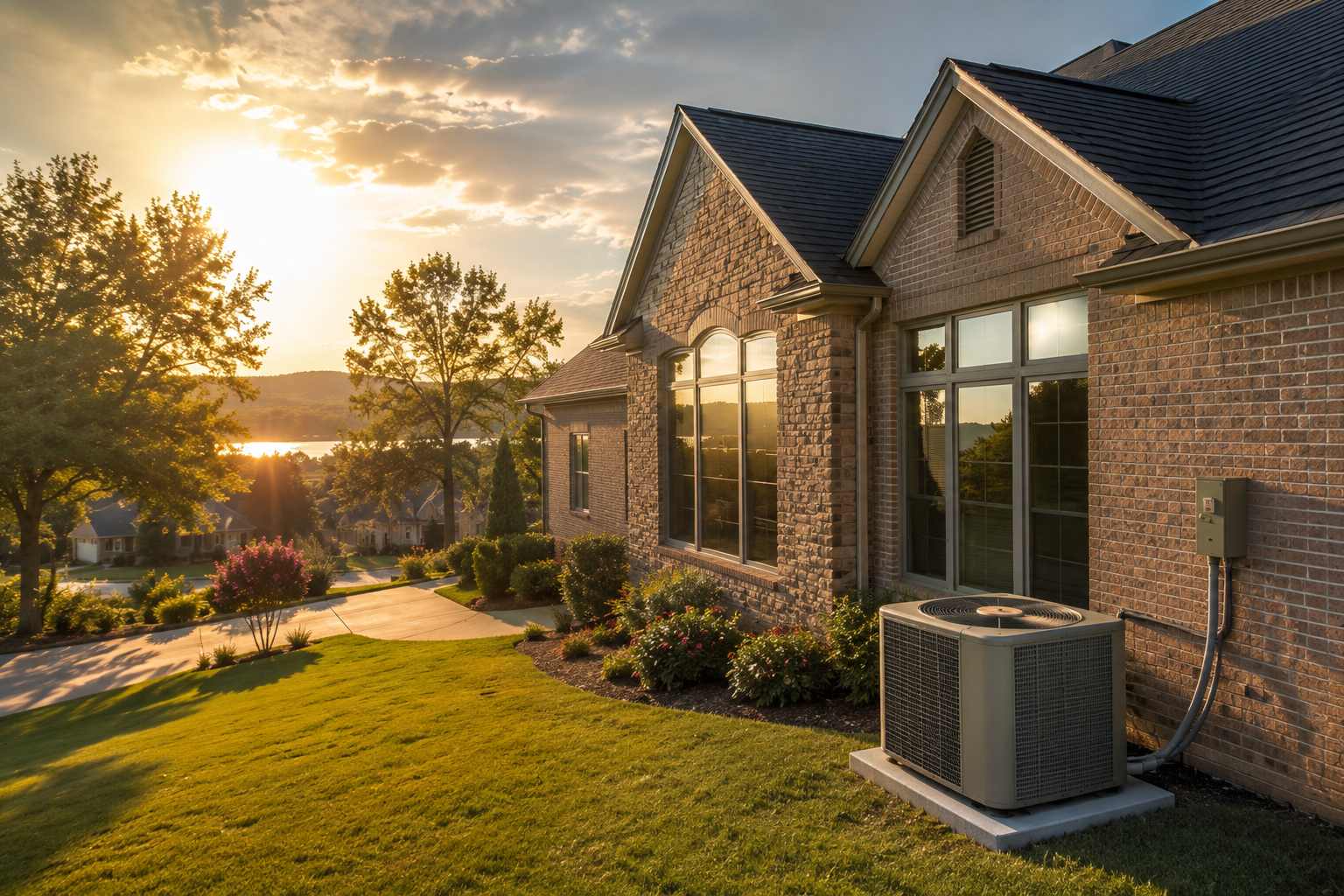
It's a late-June afternoon near the lake. The thermostat says 72, but the little "current temperature" number reads 76 and has been creeping up since about two o'clock. The air from the vents feels cold when you hold your hand to it. The system is clearly running — in fact, it hasn't shut off in hours. And yet the house keeps drifting warmer until the sun finally drops behind the trees, at which point the system slowly claws its way back to 72 by bedtime.
If that's your pattern — fine in the morning, falling behind in the afternoon, catching up at night — you're not dealing with a broken air conditioner. You're dealing with one that can't quite keep up with the load at the hottest part of the day. That's a different problem from "my AC isn't cooling," and it usually has a different answer. The good news is that the answer is rarely "buy a bigger system." More often it's a specific, measurable loss of capacity or a specific source of heat gain — and both can be pinned down with the right tests instead of guesses.
Quick Answer
What the symptom usually means: Your system is making cold air, but on the hottest afternoons your home is gaining heat faster than the equipment can remove it. The result is a house that drifts a few degrees above setpoint at peak heat, then recovers in the evening when the load drops.
Most likely causes (in plain language):
- The AC has quietly lost capacity — a dirty outdoor coil or low refrigerant — and that loss only shows up when it's hottest outside.
- Restricted airflow across the indoor coil (a loaded filter, a dirty coil, or closed/blocked vents) is choking how much heat the system can move.
- Ducts running through a 130°F attic or a humid crawlspace are losing cooling and picking up heat exactly when the attic is hottest.
- Your home is simply taking on too much heat in the afternoon — thin attic insulation, air leakage, and big west-facing windows all peak together.
- Less often, the system is genuinely undersized for the house — but that should be confirmed with a load calculation, not assumed.
Safe homeowner checks:
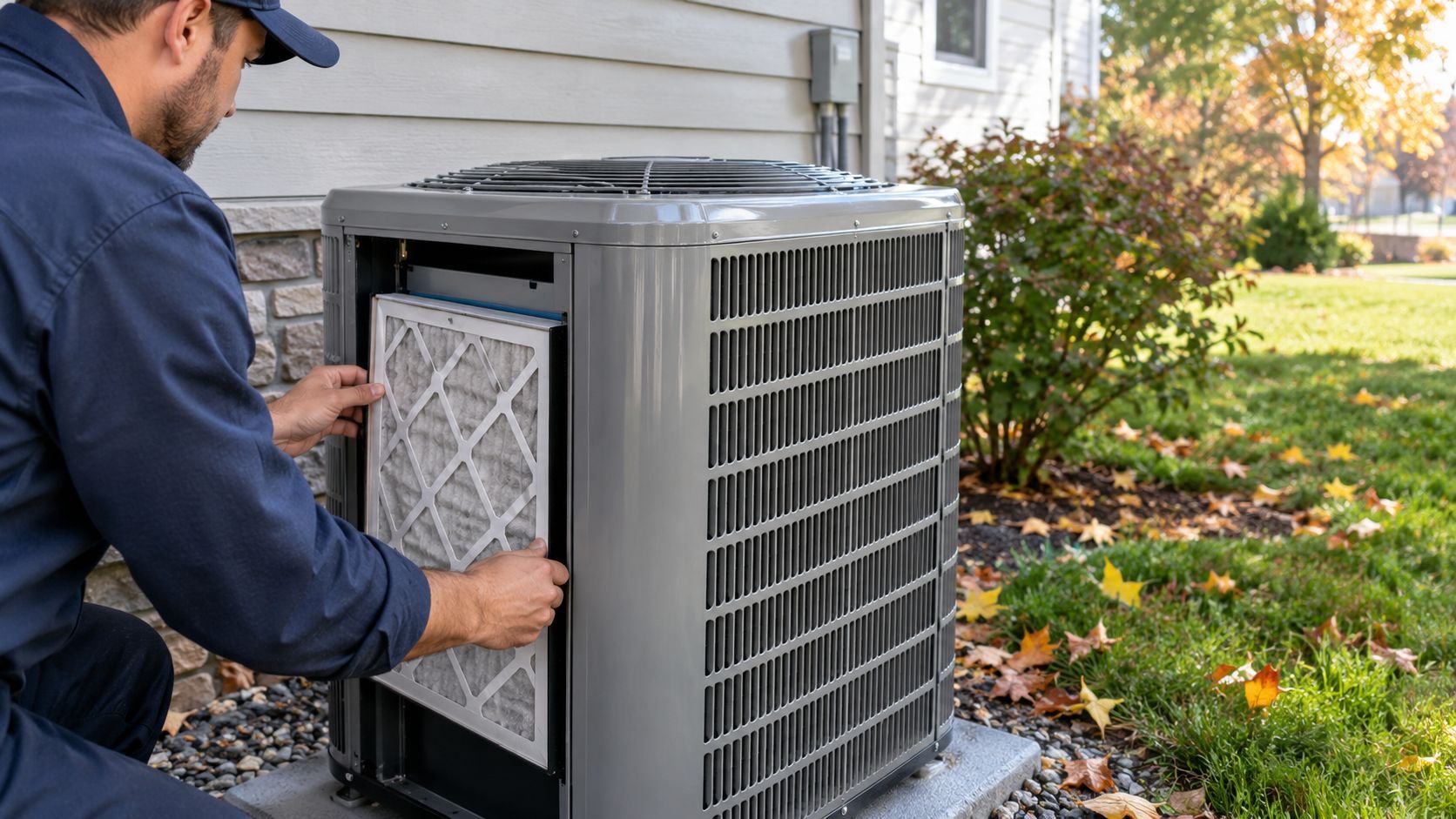
- Look at your filter. If it's gray and packed, replace it — a restricted filter is the single most common capacity-killer.
- Walk outside and make sure the outdoor unit's fan is spinning and its coil isn't matted with grass clippings, pollen, or cottonwood fluff. Give it about two feet of clear space on all sides.
- Confirm every supply register is open and nothing (rugs, furniture, closed doors) is blocking return airflow.
- Track the gap: note the indoor temperature every hour against the outdoor temperature. If the indoor number rises and falls with the afternoon sun, you've confirmed a capacity-vs-load problem.
When to call a pro: If the filter is clean, the outdoor unit is clear, and the house still can't hold setpoint within a degree or two on a hot afternoon. A thorough diagnosis should measure the temperature split across the coil, static pressure, refrigerant charge (superheat/subcooling) at high outdoor temperatures, delivered airflow, and duct leakage — and, where the question is whether the system is big enough, a Manual J load calculation.
What This Article Is About — and What It Is Not
This post is for homeowners whose air conditioner is running and is making cold air, but can't pull the house down to the thermostat setting during the hottest part of the day — typically the afternoon and early evening. The classic version: the system holds 72 easily all morning, slips to 75 or 76 by late afternoon while running nonstop, then recovers after sunset.
This is not an article about:
- A system blowing warm or lukewarm air from every vent. If the air itself isn't cold, the problem is different — start with Why Is My AC Not Blowing Cold Air? instead.
- A system that won't turn on at all — no fan, no hum, nothing.
- One room that's hotter than the rest while the rest of the house holds setpoint fine. That's usually an airflow or balance issue — see Why Is the Upstairs Hotter Than the Downstairs in My North Alabama Home?.
- A house that reaches temperature but still feels sticky and damp. That's a humidity problem, not a capacity problem, and it has its own causes — see Why Your North Alabama Home Still Feels Humid With the AC Running.
If the whole house is comfortable until the afternoon heat builds, and then slowly loses ground no matter how long the system runs, you're in the right place.
First, Why the Afternoon Specifically? (Capacity vs. Load)
Almost every cause below makes more sense once you understand the single idea at the center of this problem: your air conditioner has a capacity (how much heat it can remove per hour), and your house has a load (how much heat is coming in per hour). Comfort is just capacity winning the race against load. The reason the trouble shows up in the afternoon is that, on a hot day, both of those numbers move — and they move in the wrong directions at the same time.
Your home's load climbs through the afternoon. Outdoor temperature usually peaks in mid-to-late afternoon, not at noon. On top of that, the sun has spent hours pouring energy into your roof, walls, and windows, and that heat works its way inside on a delay (your attic and walls act like a battery that charges all day and discharges into the house). West- and southwest-facing glass gets hit hardest in the afternoon. Add the heat from people, cooking, and appliances, and your home's heat gain is at its daily maximum right around 3–6 p.m.
Your AC's capacity drops at the same time. This is the part most homeowners don't know: an air conditioner is not a fixed-size bucket. Its capacity falls as the outdoor temperature rises, because the outdoor unit has a harder time dumping your home's heat into already-hot air. A system that delivers its full rated capacity on a mild 82°F morning delivers noticeably less on a 96°F afternoon — even when nothing is wrong with it. That's normal physics, not a defect.
So picture two lines on a graph. Load is rising through the afternoon; capacity is sagging. In the morning there's plenty of daylight between them, and the house holds 72 with cycles to spare. As the afternoon builds, the lines close in. If your system has a healthy margin, they never touch and you stay comfortable. But if that margin was already thin — because the equipment lost some capacity, or the house gains more heat than it should — the lines cross, and for a few hours the load wins. The house drifts up. Then the sun sets, the load collapses, and the AC catches back up. That nightly catch-up is the fingerprint of a capacity-vs-load problem, and it's why the fix is about restoring capacity or reducing load — not about the air "not being cold."
The rest of this article walks the reasons that margin gets thin, roughly in the order we find them.
The Most Likely Causes, Ranked
These are the patterns we see most often on "runs all afternoon but won't reach setpoint" calls across Guntersville, Albertville, Arab, and the greater Marshall County area — roughly in order of how frequently they turn out to be the real culprit. Most homes that struggle in the afternoon have two of these stacked together: a little lost capacity and a little too much heat gain, which together push the margin from "comfortable" to "falling behind."
1. Your AC Is Quietly Losing Capacity When It's Hottest (Dirty Condenser, Low Charge)
What it is. Two of the most common capacity thieves are an outdoor (condenser) coil caked with pollen, grass clippings, and cottonwood fluff, and a refrigerant charge that has dropped below spec because of a slow leak.
Why it causes this symptom. Both problems cripple the system precisely when outdoor temperatures are highest. A dirty condenser coil can't reject heat well in the best conditions; on a 96°F afternoon it's overwhelmed, so the refrigerant returns indoors still carrying heat and the indoor coil can't get cold enough to keep up. Low refrigerant does the same thing — less refrigerant means less heat moved per minute, and the deficit is widest on the hottest days. On a mild morning, either problem may be invisible because there's so much spare margin. In the afternoon, that margin is gone, and the hidden loss becomes the deciding factor.
What should be measured or checked:
- Condenser coil condition and outdoor fan operation — is the coil matted, is the fan moving strong air?
- Refrigerant superheat and subcooling, measured with gauges at the actual high outdoor temperature, not by feel.
- Head pressure, which runs high when the outdoor unit can't shed heat.
- Temperature split across the indoor coil (return air vs. supply air) — typically 18–22°F on a moderate day; a low split points to a charge or airflow problem.
More likely vs. less likely. More likely if the system is more than a few years old, if cooling has slowly weakened over a season or two, if a tech has "added refrigerant" before, or if the outdoor unit sits under trees or in tight landscaping. Less likely on a newer system with a clean, open condenser and no charge history.
Homeowner vs. pro: You can clear debris and gently rinse the outside of the outdoor coil with a garden hose (power off at the disconnect, never a pressure washer). Everything involving refrigerant is pro work — it requires EPA certification and gauges, and a low charge means a leak to find and repair, not just a refill. For the full version of these failures, see
Why Is My AC Not Blowing Cold Air?
2. Restricted Airflow Across the Indoor Coil (Filter, Coil, Closed Vents)
What it is. Anything that reduces how much house air moves across the indoor coil: a loaded filter, a dirty indoor coil, a too-restrictive high-MERV filter, collapsed flex duct, or too many closed and blocked registers.
Why it causes this symptom. Capacity depends on moving the right volume of air across a cold coil. Starve that airflow and the system can't carry heat away fast enough — so it falls behind soonest on the highest-load afternoons. Restricted airflow can also let the coil get so cold it freezes into a block of ice, which cuts capacity to almost nothing; if you find frost on the indoor unit or the copper lines, read Why Is My AC Frozen Up in the Summer?
What should be measured or checked:
- Filter condition — if you can't see light through it, it's overdue. A 1-inch filter in our pollen-heavy area often needs changing every 30–60 days.
- Static pressure at the air handler — high static is the fingerprint of a restriction.
- Indoor coil cleanliness, and whether registers or returns are blocked by furniture, rugs, or closed doors.
More likely vs. less likely. More likely if it's been months since a filter change, if a very high-MERV filter was installed without checking airflow, or if vents have been closed to "push air" elsewhere. Less likely right after a fresh filter and a recent coil cleaning.
Homeowner vs. pro: Changing the filter and opening every register is fully DIY. Measuring static pressure, cleaning the indoor coil, and correcting duct restrictions are pro work. If you're choosing a filter that won't choke the system, our guide on choosing an HVAC filter for allergies and pollen walks through it.
3. Leaky or Heat-Soaked Ducts in a Hot Attic or Crawlspace
What it is. Supply and return ducts that run through an unconditioned attic or crawlspace, where they leak conditioned air, pick up heat through thin insulation, or pull hot air into the system through gaps on the return side.
Why it causes this symptom. This cause is tied to the time of day almost by definition. A North Alabama attic can hit 130°F or more on a summer afternoon. Cold air traveling through ducts in that space loses cooling before it reaches the room, and any return leaks pour superheated attic air straight into the system. The hotter the attic, the bigger the loss — which is exactly why a duct problem looks fine in the morning and bleeds capacity in the afternoon. The equipment may be making perfectly cold air at the coil while a chunk of it never reaches your living space.
What should be measured or checked:
- Duct leakage testing (a Duct Blaster or pressure pan) for a real number, not a guess.
- Supply-air temperature at the registers versus the temperature leaving the air handler — the difference reveals duct losses.
- A visual inspection of duct joints, flex runs, and insulation in the attic and crawlspace for disconnects, crushed sections, and missing wrap.
More likely vs. less likely. More likely in older homes and lake cabins, anywhere ducts run through vented attics or crawlspaces, or where attic work was done recently. Less likely in newer homes with sealed, tested ductwork inside conditioned space.
Homeowner vs. pro: Spotting an obviously disconnected duct in the attic is fine (watch your step). Measuring leakage and sealing it correctly is pro work.
4. Too Much Heat Coming In: Attic Insulation, Air Leakage, and West-Facing Glass
What it is. The building itself letting in more heat than it should — an under-insulated attic, leaky construction that lets hot outdoor air infiltrate, and large expanses of unshaded west- or southwest-facing glass.
Why it causes this symptom. This is the "load" side of the race, and every part of it peaks in the afternoon. Thin attic insulation lets the day's accumulated roof heat radiate down into the house. Air leakage drags in hot, humid outdoor air through gaps in the envelope and around the crawlspace. And west-facing windows turn into radiators as the sun swings around — a wall of afternoon glass can add a surprising amount of heat to a room at exactly 4 or 5 p.m. None of these mean your AC is broken; they mean it's being asked to remove more heat than the house should be letting in.
What should be measured or checked:
- A blower door test for whole-home air leakage — how much hot outdoor air is getting in, and where.
- Attic insulation depth and coverage, plus a look for gaps, compression, and missing baffles.
- Window orientation and shading, and surface temperatures (thermal imaging) on sunny walls and glass in the afternoon.
More likely vs. less likely. More likely in homes with large unshaded west/southwest windows (very common in lake-view houses), modest attic insulation, or a leaky envelope. Less likely in a tight, well-insulated home with shaded or low-gain glass.
Homeowner vs. pro:
Closing blinds or adding exterior shading on west glass is a real, homeowner-level help in the afternoon. Measuring air leakage, air sealing, and adding insulation are pro work — and they reduce the load permanently rather than just fighting it.
5. The Thermostat's Location Is Reading the Room Wrong
What it is. A thermostat mounted where it doesn't sense the true average temperature of the home — in direct afternoon sun, on an exterior wall, near a sunny window, or above a heat-producing appliance.
Why it causes this symptom. A thermostat only knows the temperature at its own spot on the wall. If the afternoon sun lands on it, or it sits on a wall that heat-soaks late in the day, it reads warmer than the rest of the house and keeps calling for cooling it may never feel "satisfied" delivering — so the system runs and runs without ever clicking off. It can also work the other way, where a poorly placed thermostat shuts the system off early and lets distant rooms drift. Either way, the thermostat's afternoon reading is part of the story even when the equipment is healthy.
What should be measured or checked:
- A second thermometer placed in the main living area, compared against what the thermostat reports.
- Whether sun ever falls directly on the thermostat during the afternoon.
- Thermostat location relative to supply registers, exterior walls, and appliances.
More likely vs. less likely. More likely if the thermostat is on a sunny wall, near a window, or in a spot that clearly feels different from the rest of the house. Less likely if it sits on a shaded interior wall and matches a handheld thermometer.
Homeowner vs. pro:
Comparing the thermostat to a separate thermometer is an easy homeowner check. Relocating a thermostat is a small pro job, and worth doing only after the bigger capacity and load questions are ruled out.
6. The System Is Genuinely Undersized for the Load
What it is. Equipment that truly doesn't have enough capacity to hold setpoint on a design-temperature afternoon, even in perfect condition.
Why it causes this symptom. If the air conditioner is too small for the home's actual heat gain, it will simply run out of room on the hottest days. But here's the honest part: true undersizing is less common than homeowners assume. Oversizing is the more frequent installation mistake in our area, because systems get sized by square footage or by replacing "what was there" instead of by calculation — and an oversized system brings its own problems, especially poor humidity control. So before anyone sells you a bigger unit, the question "is it actually too small?" deserves a real answer, and the only honest way to get one is a load calculation.
What should be measured or checked:
- A Manual J load calculation — the industry-standard math that accounts for your home's size, insulation, windows, orientation, air leakage, and our local climate, instead of a rule of thumb.
- Confirmation that the equipment is otherwise healthy (charge, airflow, ducts) — because a "small" system is very often a healthy system bleeding capacity to one of the causes above.
- A history check: did the home change? A finished bonus room, removed shade trees, or a converted porch can turn a once-adequate system into a marginal one.
More likely vs. less likely. More likely if a proper load calculation shows a real shortfall, if the home was added onto without upsizing the system, or if the equipment is clean, correctly charged, well-ducted, and still can't hold setpoint on a design day. Less likely as the first explanation — most "too small" systems turn out to be losing capacity somewhere fixable.
Homeowner vs. pro:
This is firmly a professional question. If replacement is genuinely warranted, the choice of equipment matters as much as the size — our honest take on that is in
Is Variable-Speed HVAC Better for Humidity Control?.
Why Guntersville and North Alabama Homes See This So Often
A few things about our climate and our housing stock make the "can't keep up in the afternoon" complaint especially common around Guntersville and the surrounding Marshall County area:
- Long, hot, humid afternoons. Our summer design temperatures sit in the mid-90s, and the humidity rarely lets up. That combination means systems run for hours at the very conditions where their capacity is lowest, so any hidden weakness surfaces in the afternoon.
- A heavy humidity load near the lake. This one is specific to lake country. Air conditioners spend part of their capacity removing moisture (latent load) and part removing heat (sensible load). Near roughly 69,000 acres of open water, the outdoor air carries more moisture, so your system burns more of its capacity wringing out humidity — leaving less to actually drop the temperature. A home a few miles inland and a hundred feet higher simply doesn't fight the same moisture load. We cover that effect in depth in Why Homes Near Lake Guntersville Have Worse Humidity Problems.
- Lake-view homes built for the view. Many homes on and around the water are designed with big west- and southwest-facing windows and wide glass doors aimed at the lake. That's a beautiful sightline and a serious afternoon solar load arriving at exactly the wrong hour.
- Ductwork in hot attics and vented crawlspaces. A lot of homes here route ducts through the worst possible thermal environment, so capacity bleeds away through duct gain and leakage on hot afternoons.
- Equipment sized by square footage, not calculation. Systems installed by rule of thumb tend to be either oversized (humidity trouble) or marginal for the real load, and either way they have little margin to spare when the afternoon peaks.
None of this means a Guntersville home is doomed to lose ground every afternoon. Plenty of homes here stay rock-steady at setpoint through the hottest part of the day. It just means the fundamentals — a clean and correctly charged system, sealed ducts, a sensible building envelope, and equipment sized to the actual load — matter more here than in a cooler, drier place.
How a Good Contractor Should Diagnose "Can't Reach Setpoint"
Anyone can guess. Good diagnosis is measured. If a contractor walks in, glances at the unit, and immediately says "it's too small, you need a bigger system" without testing anything, that's a flag — you may be about to pay for equipment when the real problem is a dirty coil, a low charge, or leaky ducts.
A thorough diagnostic for a system that can't hold setpoint in the afternoon should include, at minimum:
- Confirming the pattern: indoor temperature logged against outdoor temperature across the day, to verify the load tracks the afternoon peak and recovers at night.
- Temperature split across the indoor coil — typically 18–22°F between return and supply on a moderate day. A low split points toward airflow or charge.
- Static pressure at the air handler, to reveal a restrictive filter, dirty coil, or undersized ductwork choking airflow.
- Refrigerant superheat and subcooling, measured at the real high outdoor temperature — the only honest way to know if the charge is right.
- Condenser inspection and head pressure, since a dirty or struggling outdoor unit shows up here.
- Delivered airflow (CFM) and duct leakage testing, plus supply temperatures at the registers versus at the air handler, to catch capacity lost in a hot attic.
- A blower door test and an attic/insulation review, to measure how much heat the house itself is letting in.
- A Manual J load calculation, when the question is genuinely whether the equipment is big enough — so "undersized" is a measured conclusion, not a sales pitch.
For a single, clear failure — a dirty condenser, a low charge from a leak, a loaded filter — that's an HVAC repair visit, and you should expect a straightforward diagnosis and fix. For a system that's losing the afternoon race for reasons that stack together — capacity loss and duct gain and a heavy envelope load — our Home Comfort Consult is the more thorough path. It treats the house as a system — equipment, airflow, ducts, and the building envelope — and gives you a written, ranked plan instead of a parts-swap or an automatic upsell. If humidity and air quality are part of the picture, the Home Air Health Study adds a week of indoor air monitoring on top of the building assessment.
The goal either way is the same: stop guessing, start measuring, and only spend money on the work the data shows will actually fix the problem.
When to Act — and What Happens If You Wait
A house that drifts a few degrees above setpoint on hot afternoons isn't an emergency. But a few of these causes get worse — and more expensive — the longer they run:
- A system running wide-open at high pressure on the hottest afternoons is working at its hardest, and that's exactly when weak capacitors, struggling compressors, and dirty-coil systems tend to fail outright — often on the hottest day of the year, when you need it most.
- A slow refrigerant leak keeps getting worse, so today's small loss of capacity becomes a bigger one next season, and the compressor runs hotter than it was designed to the whole time.
- A system that can't keep up with sensible load is often losing the humidity battle too. When indoor relative humidity climbs above about 60% — common when a system runs nonstop but never satisfies — conditions where mold growth becomes possible start to appear on cooler surfaces. "Possible" is not "certain," but the risk rises the longer a home sits warm and damp, and it's higher near the lake. We don't promise that fixing capacity resolves any health symptom — that's a medical question — but moisture is a variable that can be measured and managed.
- The wrong fix is its own cost. Replacing a system that was only down on charge, or upsizing a unit that was really fighting leaky ducts, spends thousands without fixing the cause — and an oversized replacement can trade an afternoon comfort problem for a year-round humidity one.
There can also be a secondary efficiency benefit to fixing the real cause: a system with a clean condenser, correct charge, good airflow, and sealed ducts does the same job with less run time. We mention that last on purpose — it's a real perk, but the reason to fix this is comfort and protecting your equipment, not chasing a number on the power bill.
The most cost-effective approach for most homeowners is simple: handle the homeowner-level basics (filter, clear outdoor unit, open registers, shade the west glass), and if the house still can't hold setpoint on a hot afternoon, get a measured diagnosis before anyone adds refrigerant or quotes new equipment. Many of these problems are also far less likely to happen at all with regular maintenance, which is the whole point of a
maintenance membership — catching a dirty coil or a slipping charge before it leaves you sweating at 5 p.m.
Ready to Get Your Afternoons Back?
If you've changed the filter, cleared the outdoor unit, opened your registers, and your Guntersville-area home still can't hold the thermostat setting through the afternoon, the next step is a real diagnosis — not a guess and not an automatic "you need a bigger unit." An HVAC repair visit is the right fit for a single, well-defined failure, and you'll get a clear explanation of what's wrong and what it costs to fix.
If your system is losing the afternoon race for reasons that stack together — some lost capacity, some duct gain, a heavy envelope load — the Home Comfort Consult digs into the whole system and gives you a ranked, written plan, including a real load calculation so any talk of sizing is backed by math. For homeowners whose concerns also include humidity, dust, or musty odors, the Home Air Health Study adds a week of indoor air monitoring and carries our Breathe-Easy Clarity Guarantee: if, at the end of the review, you don't feel clear on what's going on in your home and what to do next, you don't pay.
No scare tactics, no guesswork, no "let's just add some refrigerant and see." Just a real diagnosis and a real plan to get your house steady at setpoint again — even at 5 p.m. in July.
Schedule an HVAC Repair Visit → Learn about the Home Comfort Consult →
Frequently Asked Questions
Why does my AC keep up in the morning but fall behind in the afternoon?
Because your home's heat gain peaks in the afternoon at the same time your air conditioner's capacity drops. Outdoor temperature usually peaks in mid-to-late afternoon, the sun has spent hours loading your roof and west-facing windows, and the attic is at its hottest — so the house is gaining the most heat right when the equipment, which loses capacity as outdoor air heats up, has the least to give. In the morning there's plenty of margin and the house holds setpoint easily; by late afternoon that margin can disappear. The nightly "catch-up" after sunset is the classic sign that this is a capacity-vs-load issue, not a system that isn't cooling at all.
Is it normal for my AC to run constantly on a 95-degree afternoon?
Yes. On a design-temperature day, a correctly sized system is expected to run almost continuously — that's how it's supposed to work, and long run times alone are not a fault. Continuous running is actually good for humidity control. The real question isn't whether it runs nonstop; it's whether it holds the setpoint while it does. If it runs all afternoon and stays within a degree or two of the setting, that's normal. If it runs all afternoon and still drifts up several degrees, that's the deficit worth diagnosing.
Does this mean my air conditioner is too small and I need a bigger one?
Usually not. True undersizing happens, but it's less common than homeowners expect — oversizing is actually the more frequent installation error in our area, and it causes its own problems with humidity. Far more often, a system that can't keep up has quietly lost capacity (dirty outdoor coil, low refrigerant, restricted airflow) or is fighting excess heat gain (leaky ducts in a hot attic, thin insulation, big west-facing windows). The only honest way to know if equipment is genuinely too small is a Manual J load calculation that accounts for your specific home — so insist on the math before anyone sells you a bigger unit.
How many degrees below the outdoor temperature should my AC be able to hold?
A properly sized, healthy system in our climate is generally designed to hold an indoor temperature roughly 20–25°F below the outdoor design temperature — so on a 95°F afternoon, holding around 72–75°F inside is reasonable. If you're asking it to hold 68°F when it's 98°F outside, you may be asking for more than any standard residential system can deliver on a peak day, even in perfect condition. But if the house drifts to 80°F every afternoon, or can't get within several degrees of a sensible setpoint, that's a real deficit and worth a measured diagnosis rather than just turning the thermostat down further.
Could the lake and humidity be why my Guntersville home won't cool in the afternoon?
It can absolutely be part of it. Your air conditioner spends some of its capacity removing moisture and some removing heat. Near Lake Guntersville, the outdoor air carries more moisture than it does a few miles inland, so the system burns more of its capacity dehumidifying — leaving less to actually drop the temperature on a humid afternoon. A heavy moisture load won't single-handedly explain a big setpoint gap, but it narrows the margin and stacks with the other causes. We explain the lake-humidity effect in detail in Why Homes Near Lake Guntersville Have Worse Humidity Problems.
About the Author
Tanner Dickerson is the owner of Dickerson Services, a North Alabama HVAC, home performance, and crawl space encapsulation company serving Guntersville, Albertville, Arab, Huntsville, and the surrounding area. He works with homeowners on complex comfort, humidity, and indoor air quality problems by treating the whole house as a system — HVAC, ducts, crawlspace, air sealing, insulation, and ventilation together.
Summary
If your air conditioner runs all afternoon but won't reach the thermostat setting in a Guntersville, Alabama home, it's almost always a capacity-vs-load problem — your home's heat gain peaks in the afternoon while the AC's capacity drops in high heat — caused most often by lost capacity (dirty condenser coil, low refrigerant, restricted airflow), duct losses in a hot attic, or excess heat gain from insulation, air leakage, and west-facing glass, with true undersizing being far less common than assumed and best confirmed by a Manual J load calculation rather than an automatic upsell to a bigger system.
Climate and Plant Selection
Selecting appropriate vegetation is crucial for the success of green roofs in the Mid-Atlantic region. Native and drought-tolerant plants are ideal, ensuring survival during dry spells and high-intensity storms. Sedums, grasses, and other hardy species maintain runoff retention and resist seasonal stress, supporting regulatory compliance throughout the year.
Share this article