
How to Get 25 Years of Life Out of Your HVAC System in Guntersville
February 23, 2026
How to Get 25 Years of Life Out of Your HVAC System in Guntersville
Most homeowners in Guntersville, Arab, Albertville, and surrounding areas are told to expect 10–15 years from a heating and cooling system.
In our experience at Dickerson Services, a lot of that “lifespan” is not about what the brochure says. It comes down to how the system is selected, installed, and set up on day one.
If we were putting a new or replacement system in our own home and wanted every possible year of safe, reliable, healthy comfort, there are six things we would insist on from any contractor. When you get these right, you give your system its best shot at lasting decades, not just years.
This article walks you through those six must‑dos and how they directly impact system life, comfort, and indoor air quality.
Important note: This focuses on installation quality, not equipment selection. If the wrong size or type of system is chosen for your home and how you live in it, even a perfect install can’t fully fix that. But these six items are non‑negotiable if you want a long‑lived system.
TL;DR
- Many HVAC systems in our area die at 10–15 years mostly because of how they’re installed and set up, not because they can’t last longer.
- To give your system its best chance at 20–25 years, you need a contractor who measures, documents, and protects the system at every step.
- Deep evacuation to 100 microns or lower reduces internal moisture and leaks that quietly kill compressors over time.
- Safe duct (static) pressure, ideally 0.15–0.3″ WC and not over 0.5″ WC, protects blower motors and reduces noise and leakage.
- Proper filtration and clean copper lines keep debris out of coils, drains, valves, and compressors, extending system life and improving air quality.
- A written commissioning report and, for inverter systems, surge protection with voltage monitoring, help prevent early failures and protect sensitive electronics.
Why So Many Systems Die at 10–15 Years
When you collect quotes, most proposals talk about:
- Brand
- Efficiency ratings (SEER, SEER2, AFUE)
- Equipment size and price
What they rarely spell out are the steps that actually determine whether your new system quietly serves you for two decades or becomes a noisy, failure‑prone 10‑year system.
You almost never see:
- How clean the refrigerant circuit is
- How hard the blower will have to work against your ducts
- How well your air is filtered before it hits the coil and blower
- Whether key startup readings were checked and documented
- How protected the electronics are from our North Alabama power events
Those hidden details are what this 25‑year checklist is about.
The 25-Year HVAC Mindset
If you want 25‑year performance, you need to think in terms of:
- Reliability first: Fewer internal stresses and failures
- Stable comfort and air quality: Systems that run as designed, day after day
- Preventing long‑term damage at install: Stopping problems before they ever start
The following six items are the minimum we’d want on any new or replacement system in Guntersville, Arab, Albertville, or Huntsville if the goal is a 25‑year system.
1. Start with a Clean, Dry System: Documented Deep Vacuum
Goal: Evacuate the system to 100 microns or lower and prove the vacuum holds.
Before adding refrigerant and starting the system, your contractor should:
- Hook up a micron gauge
- Pull a deep vacuum down to 100 microns or below
- Perform a decay test to confirm there are no leaks and no hidden moisture
Why this matters for lifespan:
- Moisture and air inside the lines can react with refrigerant and oil to form acids
- Acids and contamination attack compressor windings and internal parts
- That slowly turns a “new” system into one that is failing early from the inside out
If you want 20–25 years, you want the inside of that system as clean and dry as possible on day one.
Ask your contractor:
- “Can you document and share what the system was pulled down to in microns?”
- “Can you also document the decay test?”
A good contractor will happily text/email a clear photo of the micron gauge or provide a short evacuation report. Dismissing it or guessing based on “pump run time” is a sign they’re not thinking about long‑term life.
2. Keep the System from Fighting Your Ductwork: Documented Static Pressure
Goal: Keep total external static pressure in a safe range for your equipment.
- Ideal range: around 0.15–0.3″ WC
- Do not exceed: 0.5″ WC total external static
Why this matters for lifespan:
- High static pressure means your blower motor is working harder than it should
- That extra stress shows up as:
- Early blower failures
- Noisy operation
- More air leaking out of ducts instead of getting to your rooms
- Over years, this constant strain quietly shortens system life
To aim for 25 years, you want your system to operate in its comfort zone, not constantly at its limits.
Ask your contractor:
- “Will the static pressure be in the correct range for this equipment?”
- “Can you document and share the final static pressure of the system?”
- “If it’s out of range, what are the options to fix it?”
A quality contractor will:
- Test your existing duct pressure (if the old fan runs) before replacement
- Measure and show you the final static after install
- Explain in plain English what that number means
- Lay out clear options and costs if changes are needed
If someone says “we don’t measure that” on a $10,000–$30,000 install, they’re not designing for a 25‑year lifespan.
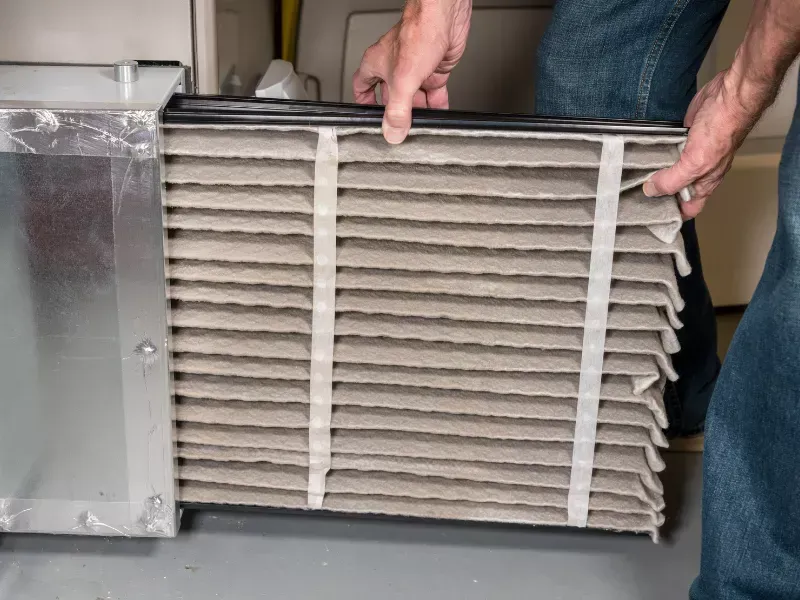
3. Protect the “Lungs” of the System: Large Media Filter Near the Unit
Goal: Install a large media filter as close to the unit as practical and seal everything around it.
Why this matters for lifespan and air quality:
- A large media filter catches fine dust and debris before they reach:
- The blower wheel
- The evaporator coil
- The duct interiors
- It helps prevent:
- Dirty, matted coils that restrict airflow and stress the system
- Clogged drains that can cause water damage or shutdowns
- Contaminant buildup that affects comfort and indoor air quality
- It typically needs to be changed less often than a 1″ filter, which makes it more likely to be changed on time
Note: It isn’t always practical or cost‑effective in every home, but it should at least be discussed honestly.
Ask your contractor:
- “What type of large media filters can you offer for my setup?”
- “How will you make sure the duct between the filter box and unit is well sealed?”
A good contractor will know these systems well, show you photos of similar installs, and focus on tight sealing so air can’t bypass the filter. That attention to detail helps keep the internal components cleaner for longer, which is key for a 20‑plus‑year life.
4. Protect the Inside of the Refrigerant Lines: Clean Copper Practices
Goal: Connect copper lines so the inside of the tubing stays clean, free of burnt debris and oxides.
When copper is brazed without protecting the interior:
- Oxides and burnt residue can form inside the tube
- Those flakes travel through the system into:
- Metering devices
- Valves
- Compressors
- Over time, that contamination clogs and damages sensitive parts, shortening system life
Ask your contractor:
- “Will you braze the line set or use press/flare fittings?”
- If brazing: “Do you flow nitrogen while brazing? If not, can you?”
For a 25‑year target, you want a contractor who either:
- Uses press/flare fittings that avoid using a torch on the line set, or
- Always flows nitrogen while brazing to keep the inside of the copper clean
Modern high‑efficiency systems have smaller passages and tighter tolerances. They simply don’t tolerate dirty lines the way older systems sometimes did.
5. Verify It’s Actually Set Up Right: Commissioning Report at Startup
Goal: Get a commissioning report at startup that shows key readings and confirms the system is running as designed.
Turning on a new system and saying “it feels cool” is not commissioning. A proper commissioning process checks and records:
- Air temperatures (supply and return)
- Refrigerant pressures, subcooling, superheat
- Airflow measurements
- Electrical readings (amps, volts)
- Any required manufacturer setup steps
We prefer MeasureQuick for this because it gives a clear, standardized report any contractor can generate. The specific tool matters less than having all key readings captured and shared with you.
Why this matters for lifespan:
- You get proof the system is actually within safe operating ranges on day one
- Future technicians have a baseline to compare against when diagnosing issues
- Small problems can be caught and corrected early, instead of running for years out of spec
Ask your contractor:
- “What kind of commissioning report do you do at the end?”
- “Could you provide a MeasureQuick report, or an equivalent written report?”
If your goal is a 25‑year system, you want documentation, not just reassurance.
6. Protect Sensitive Electronics: Surge Protection with Voltage Monitoring
(For Inverter/Variable‑Speed Systems)
Goal: Install quality surge protection with voltage monitoring for inverter/variable‑speed equipment.
High‑efficiency inverter systems offer:
- More precise comfort control
- Better dehumidification
- Often improved efficiency
They also rely on sophisticated control boards and electronics that are more sensitive to:
- Lightning‑related surges
- Utility voltage swings
- Low or high voltage conditions
For long life, those electronics need protection.
Ask your contractor:
- “Does this installation include surge protection with voltage monitoring?”
- “If not, can you add it?”
A good contractor will either:
- Include proper surge protection by default on sensitive systems, or
- Add it without pushback and be able to show you the exact device and explain how it works
For a system you hope to run for 20–25 years, leaving delicate electronics unprotected against power events is a risk not worth taking.
How to Use This in Guntersville, Arab, and Albertville
When you’re replacing a system in Guntersville, Arab, Albertville, or Huntsville:
- Treat these six items as your non‑negotiables if you care about long‑term comfort and reliability.
- Ask each contractor the specific questions listed above.
- Look for contractors who are comfortable measuring, documenting, and explaining their work in plain language.
- Understand that a slightly higher upfront price that includes these protections often costs less over 20–25 years than a cheaper install that quietly beats up your equipment.
Brand and efficiency ratings matter, but if the system is wet, contaminated, over‑pressured, dirty, unverified, and unprotected, it’s very unlikely to be your 25‑year system.
How Dickerson Services Can Help You Aim for 25 Years
At Dickerson Services, we focus on home comfort and air health first, with energy savings as a secondary benefit.
When we design and install or replace systems in Guntersville, Arab, Albertville, Huntsville, and surrounding areas, we use this 25‑year mindset:
- We evacuate and document deep vacuums before startup.
- We measure and document duct static pressure and explain what it means for your blower and comfort.
- We design for and install proper filtration, including large media filters where feasible.
- We keep the inside of copper lines clean using appropriate brazing or fittings.
- We provide a written commissioning report with key startup readings.
- For inverter/variable‑speed systems, we recommend surge protection with voltage monitoring to help guard the electronics.
If you’d rather not manage all of this yourself and want help replacing your HVAC system with a tailored, long‑life comfort and air quality solution, you can reach us at (256) 203‑6612 and we’ll walk you through your options.
Frequently Asked Questions
Can an HVAC system really last 25 years in our climate?
It’s possible, but not guaranteed. Most systems are installed in ways that limit them to 10–15 years. When equipment is properly selected, installed, documented, and protected using the six steps in this article, you give it a much better chance at 20–25 years of safe, reliable service.
What’s more important for lifespan: brand or installation quality?
Both matter, but for how long the system lives and how reliably it runs, installation quality usually matters more. A premium brand installed poorly can fail early; a solid system installed and set up correctly can serve for decades.
How does static pressure affect how long my system lasts?
Static pressure is like blood pressure for your duct system. When it’s too high, your blower works harder, runs hotter, and wears out faster. Keeping static in a safe range reduces strain, noise, and leakage, all of which support a longer system life.
Why is a commissioning report worth asking for?
A commissioning report gives you proof the system is operating within the correct ranges on day one. It makes it easier to catch small issues early and provides a baseline for future diagnostics, which helps avoid long‑term damage from unseen setup problems.
Do these steps help with indoor air quality too, or just equipment life?
They help with both. Clean copper, proper filtration, and correct airflow not only support longer equipment life, they also support cleaner air, better humidity control, and more stable comfort, which is our primary focus at Dickerson Services.
When should I bring up these six items with a contractor?
Bring them up before you sign anything. Use them during the quoting process with each contractor. The ones who are comfortable measuring, documenting, and explaining their work are the ones most likely to deliver a system that can realistically aim for 20–25 years of service.
Climate and Plant Selection
Selecting appropriate vegetation is crucial for the success of green roofs in the Mid-Atlantic region. Native and drought-tolerant plants are ideal, ensuring survival during dry spells and high-intensity storms. Sedums, grasses, and other hardy species maintain runoff retention and resist seasonal stress, supporting regulatory compliance throughout the year.
Share this article